

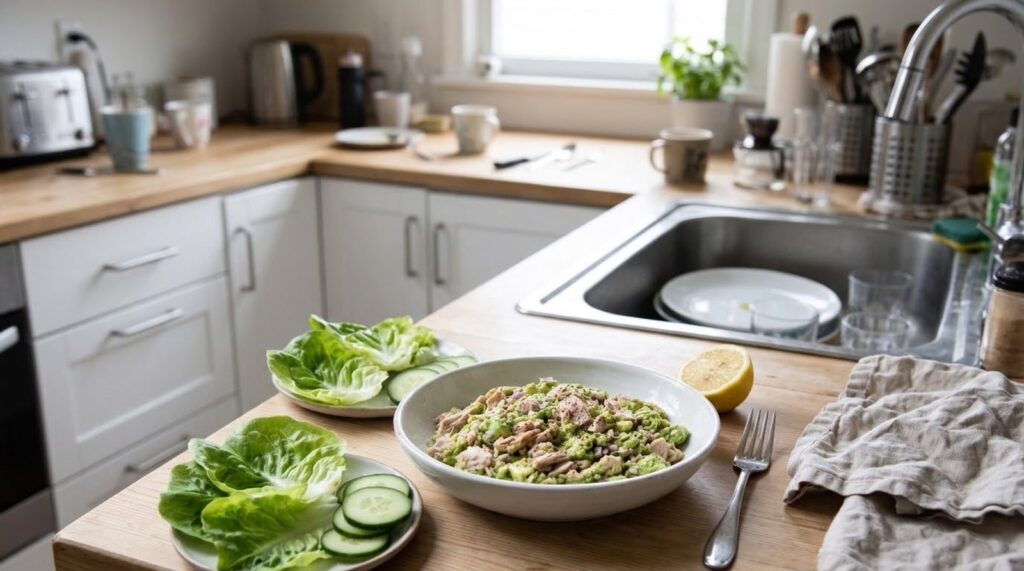
Tuna avocado salad is a can of tuna folded into mashed avocado with lemon juice, red onion, salt and pepper. It takes five minutes, needs no mayo and no cooking, and half the recipe has about 196 calories, 15g protein and 5g fiber, calculated from USDA FoodData Central.
 Save
Below you’ll find which canned tuna to buy (and how often to eat it), the avocado-to-tuna ratio, how to keep it from browning, fixes for watery or bland salad, and how long it keeps. The recipe card is further down if you just want to make it.
I make this tuna avocado salad when I want a quick lunch with real protein and I'm out of mayo, or just don't want it. It's for low-carb lunches, busy workdays and anyone trying to get 15 grams of protein in five minutes. It works because a ripe avocado mashed with lemon gives the same creamy texture as mayo, and the lemon keeps it bright and slows the browning.
The Short Version
- Ratio: 1 ripe medium avocado per 5 oz can of tuna, plus 1 tablespoon lemon juice.
- Best tuna: canned light or skipjack is on the FDA’s “Best Choices” list for mercury. Albacore is a “Good Choice”.
- Keeps: best the same day. Avocado browns, even though tuna salad itself lasts 3 to 4 days in the fridge.
- Don’t freeze it. Thawed avocado turns watery and gray.
Ingredients for Tuna Avocado Salad
Five ingredients, and each one has a job. Nothing here needs a recipe-specific shopping trip.
- 1 can (5 oz) tuna in water, drained. This is the protein. Drain it hard, pressing the lid down on the fish, because leftover liquid is what makes the salad watery.
- 1 ripe avocado. It replaces mayo as the creamy binder. Ripeness matters more than size: an underripe avocado won’t mash smooth.
- 1 tablespoon finely minced red onion. Sharpness and crunch. Mince it small so you get a little in every bite instead of big raw chunks.
- 1 tablespoon fresh lemon juice. In my kitchen the lemon does double duty: it brightens the flavor and slows browning. A full tablespoon sounds like a lot for one avocado, but it’s worth it.
- Salt and black pepper. Add them last. Canned tuna brands vary a lot in salt, so taste first.
Choosing the Canned Tuna
For most people, canned light tuna. The FDA and EPA’s advice about eating fish puts canned light tuna, which includes skipjack, on its “Best Choices” list because it’s lower in mercury. Albacore (white) tuna, canned or fresh, is on the “Good Choices” list.
That difference matters most if you’re pregnant, breastfeeding or feeding kids. For pregnancy and breastfeeding, the FDA suggests 2 to 3 four-ounce servings a week from the Best Choices list, or 1 serving a week from the Good Choices list. One 5 oz can, drained, is close to one 4 oz serving.
| Canned tuna | FDA mercury group | How it tastes in this salad |
|---|---|---|
| Light / skipjack, in water | Best Choice | Milder, softer flakes. Blends into the avocado. |
| Albacore (white), in water | Good Choice | Firmer, bigger flakes. Holds its shape more. |
| Any tuna, packed in oil | Same group as the species | Richer, but adds fat and calories. Drain well. |
Watching sodium? Check the label. Salt varies a lot from brand to brand, and some brands sell a no-salt-added version. The nutrition below is calculated without added salt.
Picking a Ripe Avocado
Hold it in your palm and squeeze gently. A ripe avocado gives a little, like a firm peach. If it feels hard, it needs a day or two. If your thumb sinks in, the flesh underneath is often brown and stringy.
Flicking off the small stem cap helps too. Green underneath usually means it’s ready; brown means it’s past its best. Need to speed one up? Put it in a paper bag with a banana or an apple, which release ethylene, the gas that triggers ripening.
Avocado Instead of Mayo
Mostly for the kind of fat. Avocado is a whole food whose fat is mainly monounsaturated, and it brings fiber and potassium with it, per USDA FoodData Central. Mayo is mostly oil and egg, with almost no fiber. Texture-wise, mashed avocado coats the tuna the same way mayo does, and it carries the lemon and onion well. The avocado gives each serving 5.1g of fiber, and per calorie only the turkey chili beats it on our list of high fiber dinner ideas.
| Avocado tuna salad | Classic mayo tuna salad | |
|---|---|---|
| Creamy base | Mashed avocado | Mayonnaise |
| Main fat | Mostly monounsaturated | Depends on the oil in the mayo |
| Fiber | About 5g per serving | Close to none |
| Best eaten | Same day (avocado browns) | Up to 3 to 4 days |
The trade-off is shelf life. Mayo tuna salad keeps for days; avocado tuna salad is a make-it-and-eat-it lunch. Want both? Use half avocado and one tablespoon of Greek yogurt or mayo.
Make it a lunch with Easy Chickpea Salad. It’s also one of the lunches on our list of high protein recipes, at 7.6g of protein per 100 calories.
Tools and Ingredient Notes
- Fork vs masher: A fork is the best tool. It leaves small chunks of avocado for texture. A potato masher works fast but tends to turn it into a smooth paste.
- Bowl: A medium bowl with room to fold. In a small bowl you end up stirring hard and breaking up the tuna.
- Pitting the avocado: Cut it in half, then scoop the pit out with a spoon. It's safer than hitting it with a knife.
- Draining the tuna: Press the lid down firmly on the open can over the sink, then flip it and press again. Getting the liquid out is what keeps the salad from turning watery.
- Onion: Mince the red onion very small with a sharp knife. Big pieces taste harsh and raw next to the soft avocado.
- Lettuce for wraps: Butter lettuce or romaine hearts make the sturdiest low-carb cups. Iceberg cracks when you fold it.
Kitchen note: Drain the tuna well and add the avocado just before serving to keep it from going watery. Taste before salting; canned tuna can already be salty.

Tuna Avocado Salad
Ingredients
Method
- In a medium bowl, mash the avocado with the lemon juice until creamy, leaving a few small chunks for texture.
- Flake in the drained tuna and add the minced red onion.
- Season with salt, pepper, and chili flakes if you like a little heat.
- Gently fold everything together. Don’t overmix, you want texture, not paste.
- Serve it on its own, with cucumber slices, or wrapped in lettuce for a low-carb taco.
Notes
- Tuna options: Chunk light tuna is milder and lower in mercury than albacore (white) tuna. Canned salmon also works.
- Stop browning: Press plastic wrap directly onto the surface and add a little extra lemon juice. Still, this is best eaten the same day.
- Add crunch: Diced celery, cucumber or chopped pickles add texture without much volume.
- Creamier: Stir in 1 tbsp Greek yogurt if your avocado is on the small side.
What to Look For at Each Stage
- A ripe avocado: It gives slightly when you press it near the stem. Pop off the little stem cap: green underneath means ripe, brown means it's past its best.
- Inside the avocado: Bright green flesh with no brown streaks or stringy fibers.
- After mashing: Creamy, with a few pea-sized chunks left.
- The tuna: Broken into small flakes, with no liquid in the bottom of the bowl.
- After folding: The pale green avocado coats every flake of tuna evenly, and a spoonful holds its shape.
- Smell and taste: It should smell fresh and lemony, not strongly fishy. If it tastes flat, it needs salt or a little more lemon.
- When it's time to eat it: If the top has gone dull and olive-colored, it has started browning. Stir it, and if it still smells fresh it's fine to eat.
How Do You Keep Tuna Avocado Salad From Turning Brown?
Cut avocado browns because an enzyme in the flesh (polyphenol oxidase) reacts with oxygen in the air. You can’t stop it, but you can slow it down two ways: add acid and keep air off the surface.
- Mash the avocado with the lemon juice first, before the tuna goes in, so the acid reaches all of it.
- Press plastic wrap directly onto the salad, not just over the bowl. Air in the gap is what browns the top layer.
- Scrape off a thin brown layer if it forms. It looks bad but is fine underneath, as long as the salad has been kept cold.
- For meal prep, keep the parts separate. Drained tuna and onion in one container, then mash a fresh avocado with lemon when you’re ready to eat.
Fixing Watery, Bland or Pasty Tuna Salad
Each problem has a simple cause, and each one is easy to fix next time.
| Problem | Likely cause | Fix |
|---|---|---|
| Watery | Tuna not drained well, or cucumber stirred in hours ahead | Press the tuna dry. Add cucumber or tomato just before serving. |
| Bland | Not enough salt or acid | Add a pinch of salt and another squeeze of lemon, then taste again. |
| Pasty | Overmixed | Mash the avocado first, then fold the tuna in gently with a fork. |
| Too fishy | Strong tuna, no fresh herbs | Try light tuna, or add chopped dill, parsley or lemon zest. |
| Lumpy | Underripe avocado | Use a softer avocado, or stir in 1 tbsp Greek yogurt to smooth it out. |
Easy Variations to Try
- Extra protein: fold in one chopped hard-boiled egg.
- More fiber: add ½ cup rinsed canned white beans or chickpeas and an extra squeeze of lemon.
- Spicy: a teaspoon of sriracha or a little minced chipotle in adobo, plus the chili flakes.
- Mediterranean: diced cucumber, halved cherry tomatoes, a few olives and crumbled feta.
- Swap the fish: canned salmon works the same way, and salmon is also on the FDA’s Best Choices list.
- Crunch: diced celery, chopped pickles or a few toasted pumpkin seeds.
What to Serve It With
To keep it low-carb, scoop it into butter lettuce leaves, pile it onto thick cucumber rounds, or stuff it into a hollowed-out tomato. For a more filling lunch, spread it on whole-grain toast or roll it into a tortilla with a handful of greens. It also goes well with a bowl of soup or a side of fruit. Two hard-boiled eggs on the side bring it to about 27.5 g of protein, as we worked out in our high protein lunch ideas for work.
How to Store It and How Long It Lasts
Food safety and quality give different answers here. According to the FoodSafety.gov cold storage chart, tuna salad keeps 3 to 4 days in the refrigerator and doesn’t freeze well. The avocado is what limits it: it browns and softens within about a day, even with lemon and plastic wrap.
- Fridge: covered, at 40°F or below. Best eaten within 24 hours.
- Room temperature: no more than 2 hours, or 1 hour above 90°F, per the USDA Food Safety and Inspection Service. Keep that in mind for packed lunches: use a cold pack.
- Freezer: not recommended.
Frequently Asked Questions
Is tuna avocado salad keto?
Yes. One serving (half the recipe) has about 7.4g carbohydrates and 5.1g fiber, so roughly 2g net carbs. Serve it in lettuce or on cucumber instead of bread to keep it that way.
Can I eat tuna avocado salad while pregnant?
The FDA lists canned light tuna as a Best Choice and albacore as a Good Choice for people who are pregnant or breastfeeding, with weekly serving limits for each. Choose light tuna, keep the salad cold, and check with your doctor about your own diet.
Can I make it the night before?
You can, but expect some browning on top. For the best texture, mix the tuna and onion the night before and mash in the avocado and lemon in the morning. It takes about a minute.
Can I use Greek yogurt as well as avocado?
Yes. A tablespoon of plain Greek yogurt makes it creamier and a little tangier, which helps when your avocado is small. It also adds a bit of protein.
Can I use frozen avocado?
Yes. Thaw frozen avocado chunks in the fridge, drain any liquid, and mash them. The texture is a little softer and wetter than fresh, so drain the tuna extra well and use a bit less lemon juice.
What can I use instead of red onion?
Sliced green onions, finely chopped chives or a minced shallot all work. Green onions and chives are milder, so you can use a little more.
How much is one serving?
The recipe makes 2 servings, about 2/3 cup each. That's enough for 3 to 4 lettuce cups or one generous sandwich.
Sources
- FDA and EPA: Advice about Eating Fish
- USDA FoodData Central (FDC 167747, 170000, 171705, 175158)
- FoodSafety.gov: Cold Food Storage Chart
- USDA FSIS: “Danger Zone” (40°F to 140°F)
