

Every gram count below comes from a cited nutrition source and was checked on July 15, 2026. This article is general information, not medical advice.
I tried fibermaxxing after seeing it all over my feed, and quickly learned that adding fiber too fast is a recipe for bloating. This guide is for anyone curious about the trend who wants more fiber from real food, without powders or stomach cramps. It works because beans, chia, berries and whole grains bring fiber along with water, protein and nutrients, and going up slowly gives your body time to adjust.
Your feed found a new obsession. TikTok’s #fibermaxxing tag is everywhere. Here’s the twist: this time, the doctors mostly agree with the algorithm. The problem is that nobody hands you the food. This guide covers what the trend actually means, whether it’s worth joining, how to ramp up without wrecking your gut, and the fibermaxxing snacks that do the job with real ingredients instead of a fortified bag.
Key Takeaways
- Fibermaxxing means deliberately maxing your daily fiber, usually toward 25 to 35 g per day.
- The hype is earned: 90% of women and 97% of men fall short of fiber recommendations (Mayo Clinic Press, 2026).
- Ramp up by about 5 g of new fiber per week, with extra water, to dodge the bloat.
- Whole-food snacks beat the new wave of fiber-fortified products on both grams and ingredients.
Fibermaxxing, explained
Fibermaxxing is the practice of deliberately maximizing your daily fiber intake, usually by loading meals and snacks with beans, lentils, fruit, vegetables, whole grains, nuts, and seeds. In 2026, Teladoc Health’s explainer put the typical “maxxing” range at 25 to 35 grams per day, which lines up with standard nutrition guidelines. In other words: the edgy TikTok trend is, quietly, just the recommended amount.
The name follows the “-maxxing” internet formula, and the trend took off through 2025 as creators filmed grocery hauls and chia-topped bowls. In other words, fibermaxxing turned one of nutrition’s oldest recommendations into a viral lifestyle. Your grandmother called it “eat more plants.” Now it has a hashtag and a color-coded meal plan.
Is fibermaxxing actually good for you?
For almost everyone, yes, because “maxxing” mostly means finally reaching normal. In 2026, Mayo Clinic Press reported that 90% of women and 97% of men don’t get the recommended daily fiber intake. When nearly the whole population is short, a trend that pushes fiber up is hard to argue with.
The payoff for closing that gap is well documented. In May 2026, NPR reviewed the trend and concluded its health benefits are “worth the hype”: better fullness, steadier digestion, and meaningful support for gut and heart health. Healthline’s 2026 rundown adds regularity and weight-management support to the list.
There is a ceiling, though. Clinicians quoted by Mayo Clinic Press note that pushing past 50 grams a day tends to bring bloating and discomfort without clear extra benefit. Targets also shift with age: roughly 25 g for women and 38 g for men under 50, easing to 21 g and 30 g after 50. The goal is meeting your needs, not winning a leaderboard. For the full gram-by-gram picture, see our complete guide to high fiber snacks.
Why fiber is suddenly everywhere
Because the food industry read the same numbers. In 2026, Supermarket Perimeter reported that fiber-focused article pageviews jumped 9,500% year over year, with 60% of Gen Z consumers telling Datassential they want more high-fiber foods. Trends don’t get cleaner signals than that.
The corporate response was fast. PepsiCo’s CEO told analysts in late 2025 that “fiber will be the next protein,” and by February 2026 the company had launched Smartfood Fiber Pop with 6 grams per serving alongside SunChips Fiber. The fortified fiber aisle is being built right now, in real time.
Sound familiar? It should. Protein went mainstream, ultra-processed protein products flooded in, and the backlash followed: by 2026, EWG was arguing that protein-fortified everything probably isn’t making us healthier. Fiber is about to run the same play. The way to fibermaxx smart is to get ahead of the fortified wave with food that never needed a label: beans, seeds, fruit, whole grains. That’s the position this whole guide is built on.
Starting fibermaxxing without the bloat
Slowly. Mayo Clinic’s long-standing guidance is to add no more than about 5 grams of new fiber per week while drinking more water. Ohio State’s 2026 explainer adds the practical version: change one meal, let your body adjust for several days, then add the next. Jumping from 15 g to 30 g overnight is how the trend earns its bloating horror stories.
The most common mistake is stacking two new high-fiber foods in the same week, say a daily bean dip on top of daily chia pudding. Add one new fiber-heavy snack at a time, and drink more water as you go.
Two more ground rules. Favor soluble-fiber foods like oats, chia, and apples early, since they tend to be gentler than a pile of raw cruciferous vegetables. A glass of chia seed water is one of the easiest ways to work them in. And if bloating shows up, hold your current level for a week instead of pushing through: persistent trouble, or a GI condition like IBS, is your cue to talk to a professional before maxxing anything.
The best fibermaxxing snacks
The best fibermaxxing snacks are whole foods carrying at least 3 grams of fiber per serving, and they beat the new fortified products on the numbers. An ounce of chia seeds (about two heaping tablespoons) holds nearly 10 grams of fiber (USDA FoodData Central, FDC 170554). The scratch version wins on grams and on the ingredient list.
Here’s the comparison nobody on the trend coverage runs: 2026’s new fortified fiber products side by side with the homemade snacks they’re imitating.
| Snack | Fiber (g per serving) | What’s in it | Whole food? |
|---|---|---|---|
| Chia pudding (2 tbsp chia) | 10 | Chia seeds, milk of choice | Yes |
| Roasted edamame (½ cup) | 9 | Edamame, oil, salt | Yes |
| Black bean dip (½ cup beans) | 8.5 | Black beans, lime, spices | Yes |
| Raspberries (1 cup) | 8 | Fruit | Yes |
| Smartfood Fiber Pop | 6 | Fortified popcorn snack (launched Feb 2026) | No, fiber-fortified |
| SunChips Fiber | n/a | Whole grains + black beans (launched Feb 2026) | Partly, processed format |
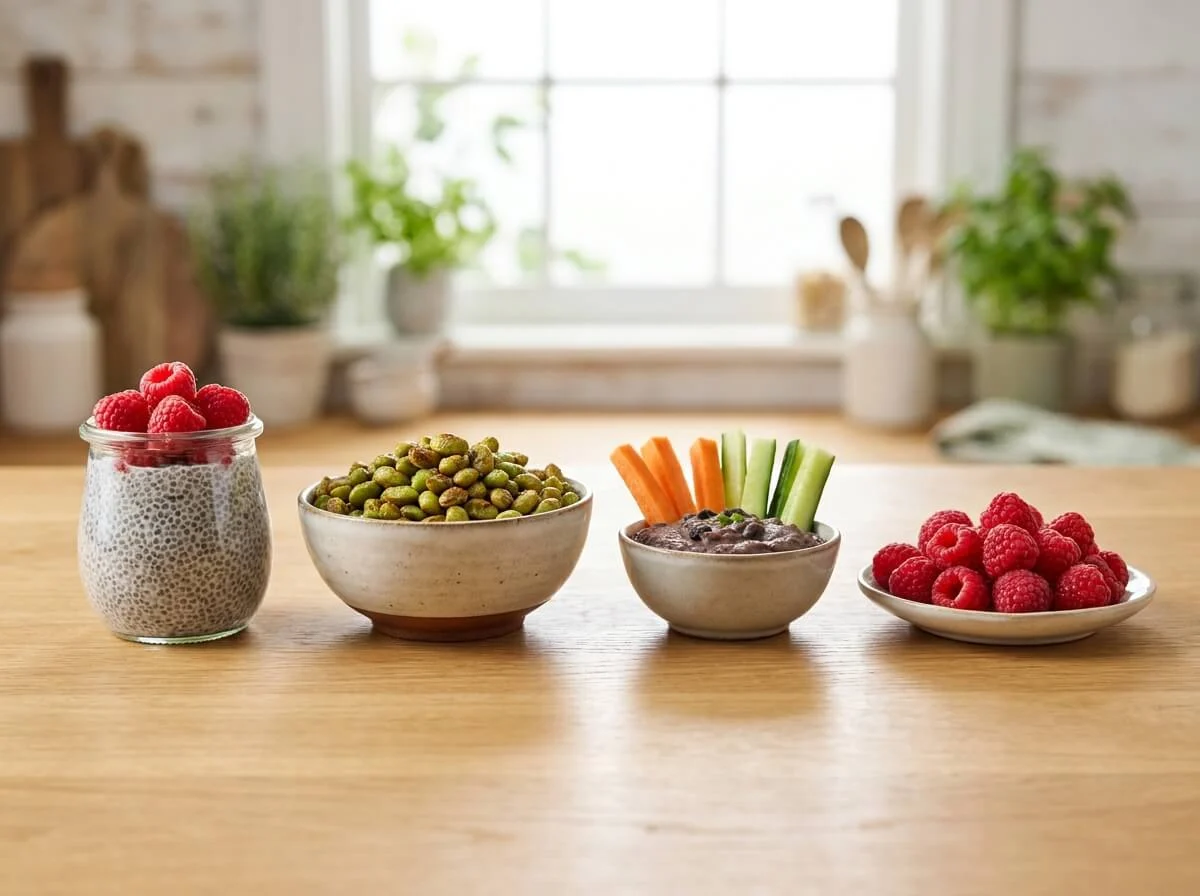
Round out the rotation with roasted chickpeas, a pear or apple with peanut butter, hummus with whole-grain crackers, and a scoop of high-fiber chickpea salad from the fridge. Every one of them clears the 3 g floor, most clear 5 g, and none needs a nutrition-marketing department.
One upgrade makes all of them work harder: add protein. Fiber and protein suppress appetite better together than either does alone, which is why the strongest picks pair both: roasted edamame is one of the few snacks that carries plenty of both. We ranked our favorites in high fiber high protein snacks.
What dietitians say about fibermaxxing
The professional consensus is unusually warm for a TikTok trend: good idea, wrong verb. Clinicians reviewing the trend, from Mayo Clinic Press and University of Utah Health to Forbes’ 2026 fact-versus-fiction review: back the whole-food version and push back on the extremes: supplement stacking, 50-gram days, and overnight jumps.
Their framing is the one worth keeping. The win isn’t “maxxing” at all: it’s meeting a target that more than 9 in 10 of us currently miss. Hit 25 to 35 grams from food, spread across the day, and you’ve extracted everything the trend has to offer. Everything past that is content, not nutrition.
What to look for at each stage
- Bean dip: Blend until smooth and creamy, adding a splash of water or bean liquid if it looks thick and pasty. It should hold a soft peak on a spoon.
- Chia pudding: Stir twice in the first 10 minutes so the seeds don’t clump. It’s ready when the gel is thick and the seeds are spread evenly.
- Roasted chickpeas: They should be golden and crunchy all the way through. Taste one once it cools; if it’s chewy, roast a few minutes longer.
- Berries: Choose plump, deeply colored berries with no wet spots or mold. Raspberries and blackberries are the most fragile, so eat them within 2 to 3 days.
- How your body reacts: A little extra gas in the first week is normal. Bloating or cramps mean you added fiber too quickly; scale back and increase by about 5 g a week.
Tools and ingredient notes
- Food processor: Makes smooth bean dip and hummus in a couple of minutes.
- Small jars: Portion chia pudding into small jars so you can grab a serving on the way out.
- Canned or dried beans: Canned beans are fast and still high in fiber. Rinse them to cut the sodium.
- Frozen berries: Just as high in fiber as fresh and cheaper out of season. Thaw them in the fridge for yogurt or pudding.
- Water bottle: Drink more water as your fiber goes up to avoid constipation.
Frequently asked questions
What is fibermaxxing?
Fibermaxxing is deliberately maximizing your daily fiber intake with fiber-rich foods like beans, fruit, whole grains, and seeds. The typical target is 25 to 35 grams per day, in line with nutrition guidelines (Teladoc Health, 2026). It’s a viral rebrand of long-standing advice.
Is fibermaxxing safe?
Yes for most people, if you ramp gradually: add about 5 grams of new fiber per week with extra water (Mayo Clinic, 2025). Clinicians report that 50+ gram days cause bloating without clear added benefit. GI conditions warrant a professional’s input first.
What should I eat to fibermaxx?
Whole-food snacks with 3+ grams of fiber: chia pudding (nearly 10 g per ounce of chia, USDA FDC 170554), roasted edamame (9 g per half cup), black beans (8.5 g per half cup), raspberries (8 g per cup), roasted chickpeas, and apple with peanut butter.
Can you fibermaxx and eat high-protein at the same time?
You should: the combination outperforms either macro alone. In a University of Minnesota satiety study, 14 grams of protein plus 5 grams of fiber curbed appetite about as well as 24 grams of protein by itself. Pick snacks that carry both, like edamame or cottage cheese with chickpeas.
Ride the trend, skip the mistakes
Fibermaxxing earns its hype for one reason: the gap is real, and more than 9 in 10 of us are living in it. Keep the playbook short. Aim for 25 to 35 grams a day from actual food. Climb 5 grams a week, with water. Pair fiber with protein so the fullness lasts. And get there with beans, seeds, and fruit before the fortified aisle finishes building itself around you.
Start tonight with the easiest 10 grams in this article, a chia pudding, then work through the Fiber Table in our high fiber snacks guide.
For a fibermaxxing lunch, try our Mediterranean dense bean salad: two kinds of beans, about 7.9g of fiber per serving, and it tastes better on day two.
Sources
- USDA FoodData Central, “Seeds, chia seeds, dried” (FDC 170554), retrieved 2026-10-13, https://fdc.nal.usda.gov/
- Teladoc Health, “Fibermaxxing explained: How you can benefit from more fiber,” retrieved 2026-07-15, https://www.teladochealth.com/library/article/fibermaxxing-explained
- Mayo Clinic Press, “Fibermaxxing: Is this TikTok trend good for you?,” retrieved 2026-07-15, https://mcpress.mayoclinic.org/nutrition-fitness/fibermaxxing-is-this-tiktok-trend-good-for-you/
- NPR, “The ‘fibermaxxing’ trend has health benefits worth the hype,” retrieved 2026-07-15, https://www.npr.org/2026/05/18/nx-s1-5821598/fibermaxxing-healthy-fiber-foods-diet-benefits
- Healthline, “‘Fibermaxxing’ May Help You Poop Better, Promote Weight Loss,” retrieved 2026-07-15, https://www.healthline.com/health-news/fibermaxxing-tiktok-nutrition-trend-health-benefits
- CU Anschutz Newsroom, “Can a Fibermaxxing Social Media Trend Reverse America’s ‘Abysmal’ Intake?,” retrieved 2026-07-15, https://news.cuanschutz.edu/news-stories/can-a-fibermaxxing-social-media-trend-reverse-americas-abysmal-intake
- Supermarket Perimeter, “Fiber competes with protein for top health trend of 2026,” retrieved 2026-07-15, https://www.supermarketperimeter.com/articles/14111-fiber-competes-with-protein-for-top-health-trend-of-2026
- Ohio State University Health, “What’s fibermaxxing, and is it good for you?,” retrieved 2026-07-15, https://health.osu.edu/wellness/exercise-and-nutrition/is-fibermaxxing-good-for-you
- Mayo Clinic, “Chart of high-fiber foods,” retrieved 2026-07-15, https://www.mayoclinic.org/healthy-lifestyle/nutrition-and-healthy-eating/in-depth/high-fiber-foods/art-20050948
- Forbes, “The ‘Fibermaxxing’ TikTok Trend: Here’s What’s Fact Versus Fiction,” retrieved 2026-07-15, https://www.forbes.com/sites/brucelee/2026/05/03/the-fibermaxxing-tiktok-trend-heres-whats-fact-versus-fiction/
- EWG, “Protein is everywhere. It probably isn’t making us healthier,” retrieved 2026-07-15, https://www.ewg.org/news-insights/news/2026/05/protein-everywhere-it-probably-isnt-making-us-healthier
- University of Minnesota Digital Conservancy, protein and fiber satiety study, retrieved 2026-07-15, https://conservancy.umn.edu/items/c0adb896-40c0-4127-b7a6-930525897a4f
Building lunches around the same idea? Try these no-reheat lunch boxes with 30g protein.
Want that fiber in something you can toast? These cottage cheese bagels carry about 4.8g of fiber each, close to triple a plain bagel.
