

Cottage cheese is having a moment. It’s blended into ice cream, baked into chips, and scooped straight from the tub for the protein. But there’s one line on the label almost nobody reads, and it isn’t the protein. It’s the sodium. A single half-cup can carry 350 to 450 milligrams, and if you eat two servings a day, that number climbs fast. The same tub also turns into cottage cheese bagels, where how much sodium you started with matters more than you would expect.
I started looking at sodium when I realized two servings of cottage cheese a day were adding up fast. This guide is for anyone watching their blood pressure, following a low-sodium diet, or eating cottage cheese every day for the protein. It works because you have three easy options: buy a no-salt-added brand, rinse regular cottage cheese, or make your own at home without salt.
Here’s the good news. You don’t have to give up your favorite high-protein snack. You just have to be smarter about which tub you grab, or make your own. This guide covers the lowest-sodium brands, an easy homemade recipe, and a rinse trick that cuts the salt from what’s already in your fridge.
Key Takeaways
• In 2025, Tasting Table reported regular cottage cheese carries 350-450mg of sodium per 1/2 cup, which adds up quickly if you eat it every day.
• No-salt-added brands like Friendship Dairies drop that to about 45mg per serving.
• A homemade batch made with milk and vinegar has no added salt: under about 140mg per half-cup, and less once the whey drains off.
• The fix isn’t cutting cottage cheese. It’s choosing the right version.
How much sodium is in cottage cheese?
In 2025, Tasting Table reported that a half-cup of regular cottage cheese contains roughly 350 to 450 milligrams of sodium, and a full cup of the 2% variety can top 900mg (Tasting Table, 2025). That’s a lot for a food most people file under “healthy.” The salt isn’t there by accident. Cottage cheese is high in moisture, so salt gets added as a preservative and for flavor.
The catch is how quietly it stacks up. In 2025, the American Heart Association reaffirmed a cap of 2,300mg of sodium per day, with an ideal target of 1,500mg for most adults (American Heart Association, 2025). Two servings of regular cottage cheese can eat more than half of that ideal budget before you’ve touched anything else.
Most of us are already over the line. As of 2025, the American Heart Association estimates as much as 75% of the sodium Americans eat comes from processed and prepared foods, not the salt shaker. Cottage cheese is exactly the kind of “healthy” processed food hiding in that 75%. So how big is the gap between a regular tub and a low-sodium one? It’s enormous.
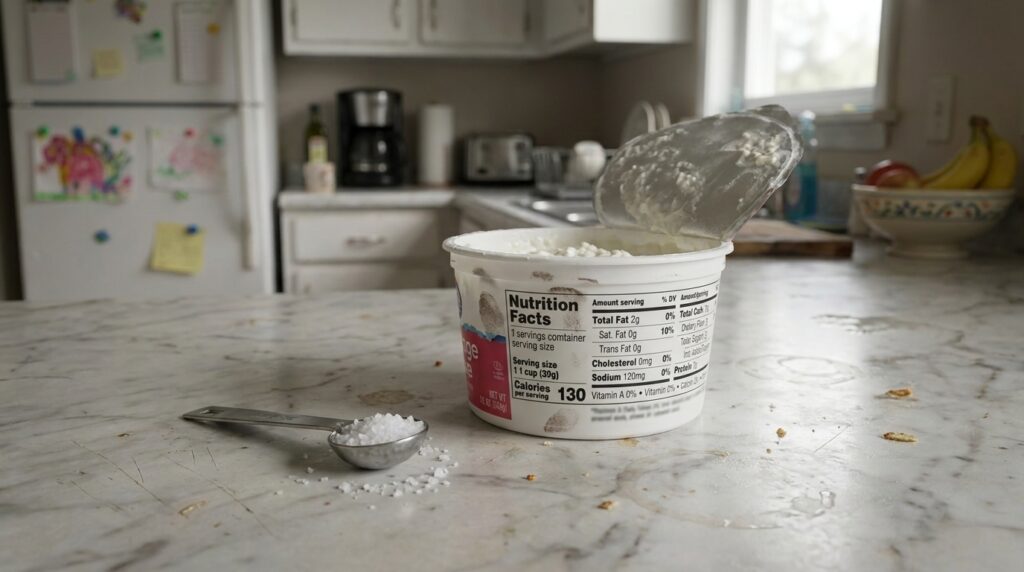
Fitting cottage cheese into a lower-sodium diet
Yes. The sodium comes from salt added during production, not from the dairy itself, so the version you buy makes the difference. A no-salt-added or homemade tub gives you the same protein and calcium with a small fraction of the sodium.
If you are watching your sodium intake, compare the nutrition labels of a few products before you buy, and check the serving size too: some tubs list 1/4 cup instead of 1/2 cup, which makes the sodium look lower than it is. Eating patterns like the DASH eating plan from the National Heart, Lung, and Blood Institute include low-fat dairy and set specific daily sodium levels. If you follow a sodium limit for a medical reason, your doctor or dietitian should set that number, not a recipe site.
The best low sodium cottage cheese brands
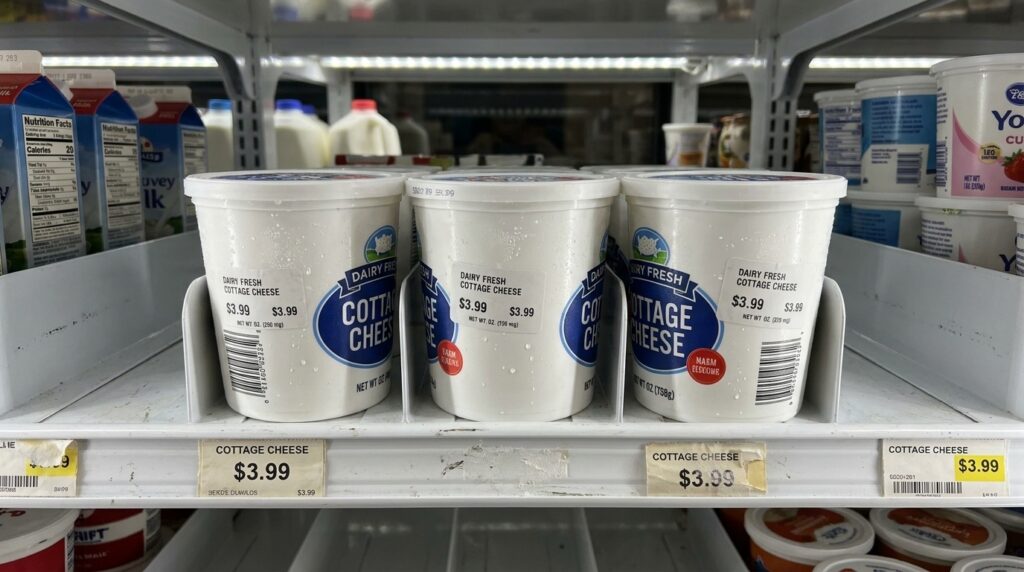
The lowest-sodium option most stores carry is Friendship Dairies No Salt Added, at about 45mg per half-cup, roughly a tenth of a regular tub (Easy & Cozy Recipes, 2026). As of 2025, WellND reports no-salt-added lines in general run anywhere from 15 to 60mg, versus the 350-450mg baseline (WellND, 2025). If your store doesn’t stock one, farmer cheese is a firmer, naturally lower-sodium cousin worth a look.
Here’s how the common options compare. Always confirm against the current package, because brands reformulate and numbers drift.
| Brand / type | Sodium (per 1/2 cup) | Notes |
|---|---|---|
| Generic “no salt added” | ~15mg | Lowest tier; hardest to find |
| 365 Whole Foods Farmer Cheese | ~25mg (per 1/4 cup) | Firmer texture, mild |
| Generic “low sodium” | ~30mg | Label-dependent |
| Friendship Dairies No Salt Added | ~45mg | Widely available |
| Good Culture No Salt Added | ~60mg | Adds live probiotics |
| Regular cottage cheese | 350-450mg | The baseline you’re beating |
What we found on the shelf: When we compared tubs side by side in our kitchen, the no-salt-added versions tasted noticeably milder, closer to fresh milk than to the tangy, salty stuff most people grew up on. That’s not a flaw. It’s a blank canvas, and the flavor section below fixes it in about ten seconds.
How to make low sodium cottage cheese at home
You can make cottage cheese with no added salt using two ingredients: milk and an acid. The only sodium is the small amount naturally in milk, and much of it drains away with the whey. Four cups of whole milk carry about 420mg of sodium (USDA FoodData Central, FDC 171265), so even if every milligram stayed in the 1.5 cups of curds, a half-cup would have under 140mg. The whole thing takes about 45 minutes, most of it hands-off, and it costs less than a name-brand tub. The method is simple curds-and-whey chemistry. You warm milk, add vinegar or lemon juice to separate the curds, drain, and rinse.
That rinse is the secret. It washes away residual whey and any trace saltiness, leaving a clean, creamy curd. Sodium can’t be measured in a home kitchen, so we don’t give a number for homemade curds: it depends on how much salt you add and how well you rinse. For comparison, a half-cup of regular store-bought cottage cheese has about 350 to 450mg of sodium, along with the roughly 13g of protein cottage cheese is loved for (Consumer Reports, 2025).
Easy Low-Sodium Cottage Cheese
Yield: about 1.5 cups · Time: 45 minutes · Sodium: no salt added (under about 140mg per 1/2 cup)
Ingredients
- 4 cups (1 quart) whole milk
- 3 tablespoons white vinegar or fresh lemon juice
- Optional: 1 tablespoon milk or cream, to loosen at the end
Steps
- Warm the milk in a saucepan over medium heat to about 120°F, stirring so it doesn’t scorch.
- Take it off the heat, pour in the vinegar, and stir slowly for 1 to 2 minutes. The curds will separate from the cloudy whey.
- Cover and let it rest at room temperature for 30 minutes.
- Line a colander with cheesecloth and pour in the mixture. Let it drain for about 5 minutes.
- Gather the cloth and rinse the curds under cold water for 3 to 5 minutes, gently squeezing, until cooled and clean-tasting.
- Squeeze out the excess liquid. Stir in a splash of milk or cream for a creamier texture if you like.
Store it in an airtight container in the fridge for up to 4 to 5 days. Because there’s no added salt preserving it, homemade won’t last as long as store-bought, so make it in small batches.
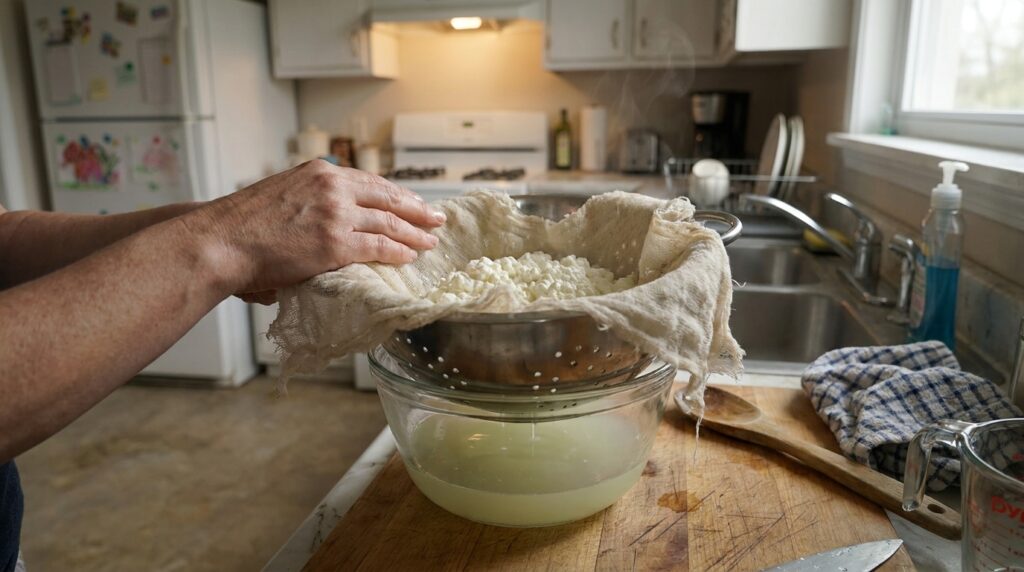
What rinsing does to the sodium
Yes. Draining regular cottage cheese in a fine strainer and rinsing it under cold water washes away a chunk of the surface salt sitting in the surrounding liquid. It’s the fastest fix when a no-salt-added brand isn’t on the shelf and you don’t have time to make your own. How much does it cut? Enough to matter, though not as much as making your own from scratch.
The trade-off is texture. You’ll rinse away some of the creamy dressing, so the curds come out drier and a little less rich. Stir a spoonful of plain milk or a dollop of plain Greek yogurt back in and, in our experience, most people can’t tell the difference.
Nobody frames the rinse trick with real numbers, but it’s the most practical option for the average shopper. It won’t get you down to homemade’s 15mg, yet it meaningfully trims the surface sodium off a 400mg tub in under a minute. Think of it as the middle path between grabbing a salty tub and cooking a batch from scratch. A small effort, a real payoff.
Adding flavor back without salt
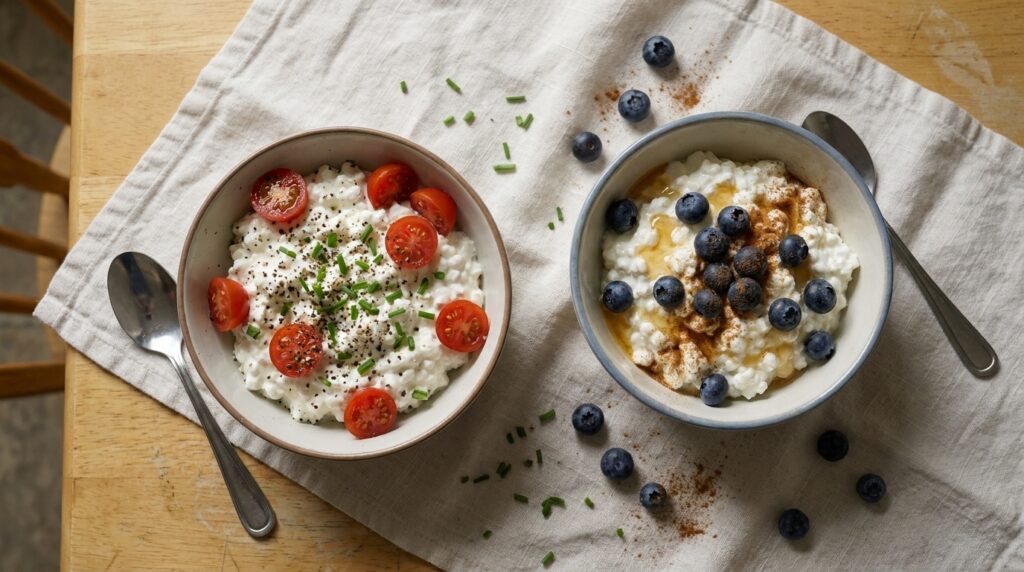
Low-sodium doesn’t have to mean flat. The salt was doing two jobs, seasoning and tang, and you can replace both with ingredients that add zero or almost zero sodium. Acid, herbs, and a good salt-free seasoning blend do the heavy lifting. Want it savory or sweet? Either works, and neither needs the salt.
For savory bowls, reach for cracked black pepper, fresh chives, a squeeze of lemon, everything-bagel seasoning (look for the salt-free version), or a few dashes of hot sauce (check the label, since some are salt bombs). For sweet, the cottage cheese barely needs help. Berries, a drizzle of honey, cinnamon, or a spoon of nut butter turn it into dessert.
This is exactly the base that makes our creamy 4-ingredient protein pops and crispy cottage cheese chips work so well. A clean, mild curd takes on whatever you give it.
Low sodium cottage cheese nutrition
Cutting the sodium keeps everything people actually want from cottage cheese. As of 2025, Consumer Reports notes a half-cup still delivers around 13g of protein, more than 300mg of calcium, and only about 100 calories (Consumer Reports, 2025). The salt was never the nutrition. It was just seasoning.
That protein number is why cottage cheese exploded as a snack in the first place. As of 2025, the American Dairy Association reports 13 to 14g of protein per half-cup depending on fat level, plus about 13% of your daily calcium (American Dairy, 2025). Going low-sodium changes none of that.
Looking for more ways to use the tub? See all of our cottage cheese recipes, from breakfast to dessert.
A lower-sodium tub also works well in our cottage cheese queso, since the cheddar and Rotel already bring plenty of salt.
What to look for at each stage
- Warming the milk: At about 120°F the milk feels like hot bath water and is just starting to steam, with no bubbles. Stir the whole time so a skin doesn’t form or scorch on the bottom.
- Adding the vinegar: Within a minute or two of slow stirring, the milk splits into soft white curds and a cloudy, yellowish whey. If it still looks like plain milk, it may not have been warm enough.
- Resting: After 30 minutes the curds should have settled and firmed up slightly, with clearer whey around them.
- Rinsing: Rinse under cold water until the curds feel cool and taste clean, with no sharp vinegar note. That rinse is also what takes the sodium down.
- Finished texture: After squeezing, the curds should be moist but not dripping. A splash of milk or cream makes them creamy like store-bought. A sour or yeasty smell after a few days means it’s time to toss it.
Tools and ingredient notes
- Milk: Whole milk gives the most curds and the creamiest result. Ultra-pasteurized milk often won’t curdle well, so use regular pasteurized milk.
- Vinegar or lemon juice: Distilled white vinegar has the most neutral flavor. Lemon juice works too but leaves a light citrus taste.
- Thermometer: A digital thermometer helps you stop at about 120°F instead of guessing.
- Colander and cheesecloth: Line a colander with cheesecloth or a thin, clean kitchen towel so the small curds don’t wash away.
- Reading labels: Compare sodium per 1/2 cup serving. No-salt-added brands are far lower, while ‘reduced sodium’ can still be fairly high.
Frequently Asked Questions
How much sodium is in cottage cheese?
In 2025, Tasting Table reported regular cottage cheese has about 350 to 450mg of sodium per 1/2 cup, and a full cup of 2% can exceed 900mg (Tasting Table, 2025). No-salt-added versions cut that dramatically, to between 15 and 60mg per 1/2 cup depending on the brand.
What is the lowest sodium cottage cheese brand?
No-salt-added lines are lowest, around 15 to 45mg per 1/2 cup. As of 2026, Friendship Dairies No Salt Added (~45mg) is the most widely available (Easy & Cozy Recipes, 2026). Good Culture No Salt Added runs about 60mg and adds probiotics. Farmer cheese is another naturally low-sodium option.
Can you make cottage cheese without salt?
Yes. Warm 4 cups of milk, add 3 tablespoons of vinegar to separate the curds, drain through cheesecloth, and rinse under cold water. No salt goes in, so the only sodium is what is naturally in the milk. For comparison, regular store-bought cottage cheese has about 13g of protein per half-cup (Consumer Reports, 2025).
Does rinsing cottage cheese reduce sodium?
Yes. Draining and rinsing the curds under cold water washes away surface salt in the surrounding liquid. It costs you a little creaminess, which you can restore by stirring in a splash of milk or plain yogurt. It’s the quickest fix when no low-sodium brand is available on the shelf.
Which cottage cheese should I buy if I’m watching sodium?
Look for a tub labeled “no salt added,” then confirm the sodium and the serving size on the nutrition panel, since brands reformulate. If you can’t find one, farmer cheese or the homemade version above are the lowest-sodium options, and rinsing a regular tub trims some of the surface salt.
In short
Cottage cheese earned its comeback for good reason: high protein, high calcium, low calorie. The one weak spot is the sodium, and that’s the easiest part to fix.
- Regular tubs hide 350-450mg of sodium per 1/2 cup.
- No-salt-added brands (Friendship, about 45mg) cut it by roughly 90%.
- Homemade with milk and vinegar has no added salt (under about 140mg per half-cup).
- A quick rinse trims the salt off whatever’s already in your fridge.
- Acid, herbs, and fruit bring the flavor back for free.
Ready to put it to work? Make a batch of the homemade version above, then use it in our 3-ingredient high-protein ice cream or scoop it into more 15g-protein snack ideas.
About the author
Alex is the Founder & Recipe Developer at Flavor Flip, where every recipe is made and tasted in a home kitchen before it’s published, not built in a lab.
Sources
- Tasting Table, “The One Nutritional Fact You Should Pay Attention To When Buying Cottage Cheese,” retrieved 2026-07-24.
- American Heart Association, “Shaking the Salt Habit to Lower High Blood Pressure,” retrieved 2026-07-24.
- National Heart, Lung, and Blood Institute, “DASH Eating Plan,” retrieved 2026-07-24.
- Consumer Reports, “Is Cottage Cheese Good for You?,” retrieved 2026-07-24.
- American Dairy Association, “Cottage Cheese Health Benefits and Nutrition Facts,” retrieved 2026-07-24.
- WellND, “Cottage Cheese Sodium Content,” retrieved 2026-07-24.
- Easy & Cozy Recipes, “Low Sodium Cottage Cheese,” retrieved 2026-07-24.
Brand sodium figures change when products are reformulated, so always check the current package label. This article is general nutrition information, not medical advice.
This swap does the most work in the lunch box where low-sodium cottage cheese matters most.
