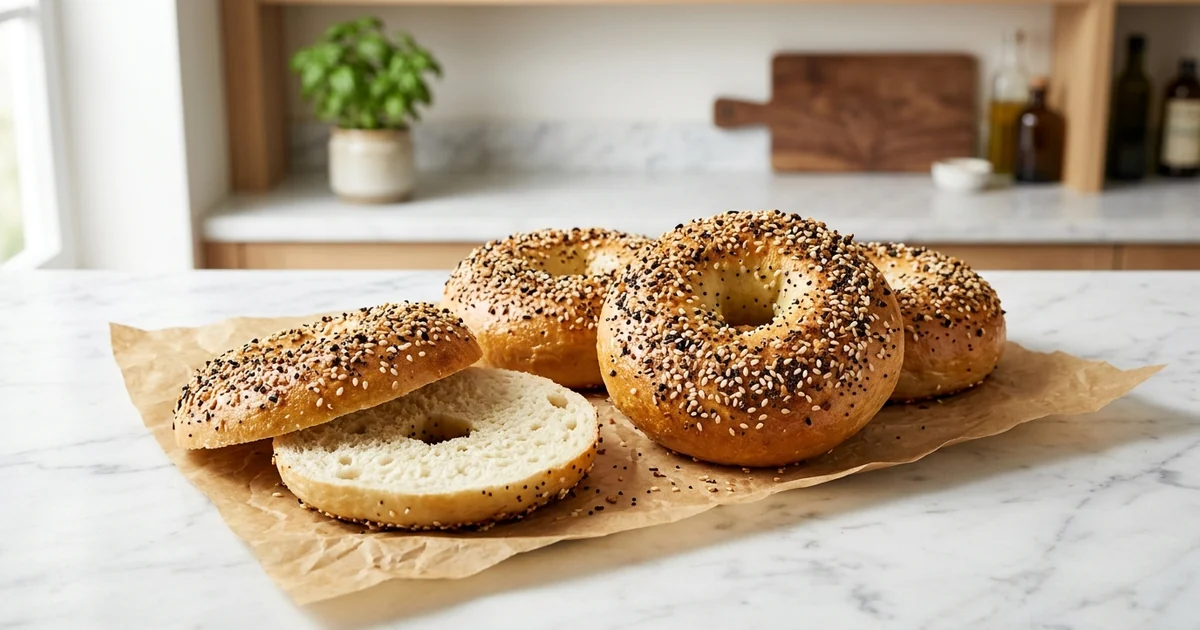
Cottage Cheese Bagels (12g Protein, 5g Fiber)
A standard plain bagel gives you 11.1g of protein and just 1.7g of fiber per 105g bagel (USDA FoodData Central, FDC ID 174899). Swap the water for blended cottage cheese, add two things nobody else adds, and you can roughly triple the fiber in about 35 minutes, with no yeast and no rising time.
Here’s the part most versions of this recipe skip. The viral two-ingredient bagel is a modest protein upgrade and a complete fiber blank, because self-rising flour brings almost none and cottage cheese brings exactly zero. This version fixes that. It also answers the question that fills every comment section on every other cottage cheese bagel post: why is the dough so sticky?
Key Takeaways
- About 12g protein and 4.8g fiber per bagel, against 11.1g and 1.7g in a plain bagel (USDA, FDC ID 174899).
- Fiber is the real gain at nearly triple. The protein edge is only about 12%.
- Sticky dough is loose whey. Strain the cottage cheese rather than adding flour.
- Oven 375F for 25 minutes, or air fryer 350F for 12 to 14 with a flip at 8.
What Are Cottage Cheese Bagels?
Cottage cheese bagels are a no-yeast, no-boil bagel where blended cottage cheese replaces the water, the fat and nearly all of the proofing time. In 2024, cottage cheese sales rose 9.2% globally, with North America driving most of that growth (The Insight Partners, Cottage Cheese Market report). This recipe is what happens when that boom reaches breakfast bread.
A real bagel is a yeasted dough that proofs, gets boiled in malted water, then bakes. That’s what gives it the dense chew and the glossy skin. These skip all of it. Chemical leavening does the lifting, the cottage cheese supplies moisture and protein, and the whole thing goes from bowl to oven in about ten minutes.
So they aren’t bagels in the strict sense. They’re a soft, high-protein roll shaped like a bagel, and they toast beautifully. If you’re expecting the chew of a boiled New York bagel you’ll be disappointed. If you’re expecting something that holds cream cheese and smoked salmon at 7am on a Tuesday, they deliver.
Why did they take off? Protein is the whole story. As of 2025, roughly 64% of regular cottage cheese buyers named protein content as their main reason for buying it (Tastewise, Cottage Cheese Trends), and North America now accounts for $2.17 billion, or 38.7%, of global cottage cheese revenue (The Insight Partners). It’s the same reason the tub keeps turning up in desserts, dips and blueberry cottage cheese ice cream.
Are Cottage Cheese Bagels Actually Healthy?
They beat a standard plain bagel on both, but not by the margin the trend implies. As of 2026, one cup (226g) of 2% cottage cheese supplies about 25g of protein (USDA FoodData Central, FDC ID 328841), spread across four bagels. The fiber gap is where the real difference sits.
Here’s the honest accounting for one batch of four bagels, using the formulation below.
Look closely at those two bars and you’ll see the trend oversells one number. The protein gain is about 12%, roughly a gram and a half. Real, but nobody’s macros change because of it. The fiber goes from 1.7g to 4.8g, which is close to triple, and that’s the number worth making these for. For comparison, even an oat bran bagel carries only about 3.6g of fiber per 100g (USDA FoodData Central, FDC ID 172666), so this beats the supermarket’s “healthy” bagel too.
The part the trend skips. Cottage cheese contains zero fiber. None. Made the viral way, with cottage cheese and plain self-rising flour only, these land near 0.8g of fiber per bagel, which is worse than the plain bagel they’re supposed to replace. The psyllium and whole wheat below aren’t optional extras or a health-nut upgrade. They’re the entire reason this version beats the thing it’s competing with.
That matters more than it sounds. The Dietary Guidelines call for 22 to 34g of fiber a day depending on age and sex, and most American adults eat around 16g (Cleveland Clinic). In fact, only about 5% of US adults hit the target at all (Tufts University).
One more piece of context, and it cuts both ways. A 2025 randomised trial in the European Journal of Nutrition found that a 30g-protein breakfast produced stronger PYY and GLP-1 satiety hormone responses than a 10g high-carbohydrate control (European Journal of Nutrition, 2025). Participants felt fuller. But the same trial found they did not eat less at lunch (News-Medical summary, 2025). A high-protein breakfast helps appetite. It isn’t a calorie deficit on its own.
For the wider picture on hitting your daily target, we went through it in detail in how much fiber you actually need per day.
What You Need
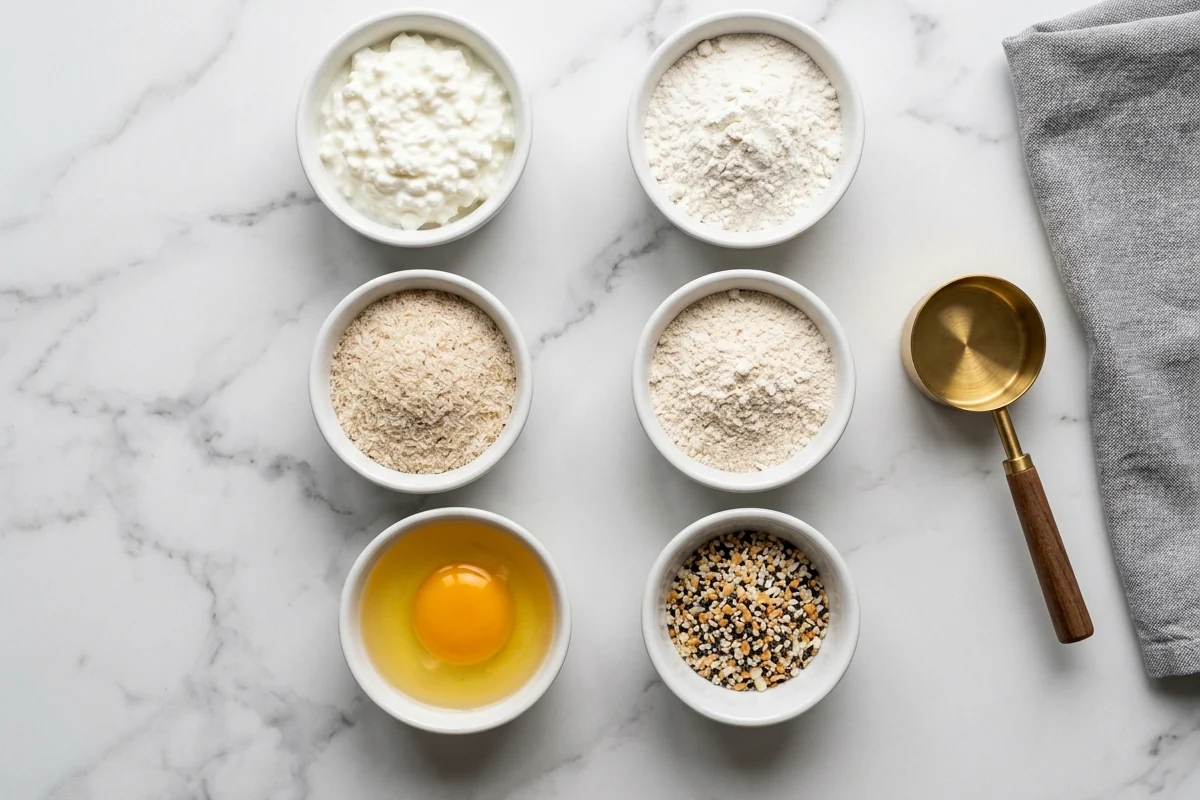
Five ingredients, and three of them are doing work most recipes don’t ask of them. The viral version uses two, cottage cheese and self-rising flour, which is where its fiber problem comes from. Adding whole wheat flour and psyllium husk is what takes a batch from roughly 0.8g of fiber per bagel to 4.8g. This makes 4 bagels.
- 1 cup (226g) 2% cottage cheese
- 1 cup (120g) self-rising flour
- 1/2 cup (60g) white whole wheat flour
- 2 tbsp (12g) psyllium husk
- 1 large egg, beaten, for the wash
- Everything seasoning, or see the variations below
 Save
SaveCottage cheese: use 2%. This is the single most consequential choice in the recipe. 2% cottage cheese is about 11% protein and 81% water by weight (USDA FoodData Central, FDC ID 328841). Fat-free carries the same water and none of the fat, and fat is what keeps the crumb tender. Fat-free bakes gummy. 4% works and gives a richer result, with slightly less protein per gram.
No self-rising flour? Use 1 cup all-purpose flour plus 1 1/2 tsp baking powder and 1/4 tsp salt. That’s the whole conversion.
Psyllium husk is the fiber engine here, and it’s worth weighing rather than scooping. Whole psyllium husk runs around 80% dietary fiber by weight on typical product labels, so the 12g called for here contributes roughly 9.6g of fiber, more than both flours combined. Check your own tub, since brands vary. It also behaves unlike anything else in the bowl, which is covered in the sticky dough section.
On the topping. Everything seasoning is the default for a reason, but it stacks salt onto a food that already carries plenty. A plain bagel runs about 422mg of sodium per 100g before you add anything (USDA FoodData Central, FDC ID 174899), and everything seasoning is largely salt, dried garlic and dried onion. If you’re watching sodium, sesame and poppy alone give you most of the effect. We covered the wider question in choosing a lower-sodium cottage cheese.
How Do You Make Cottage Cheese Bagels?
Blend the cottage cheese smooth, stir it into the dry ingredients, rest the dough five minutes, then shape and bake. Total time is about 35 minutes, and only ten of those are hands-on. There’s no proofing stage and no boiling stage, which is what separates this from a real bagel and why it fits a weekday morning. Heat the oven to 375F (190C) now, or the air fryer to 350F (175C).
- Blend the cottage cheese until completely smooth, 30 to 45 seconds in a blender or food processor. Stop when there are no visible curds. This step is what makes the finished bagel read as bread rather than as baked cheese.
- Whisk the dry ingredients together in a bowl: self-rising flour, white whole wheat flour and psyllium husk.
- Combine. Pour the blended cottage cheese into the dry mix and stir with a spatula until it comes together into a shaggy dough.
- Rest for 5 minutes. Don’t skip this and don’t add flour yet. See below for why.
- Knead for 1 to 2 minutes on a lightly floured surface, just until smooth. Overworking makes them tough.
- Divide into 4 equal pieces. A scale helps here, roughly 105g each.
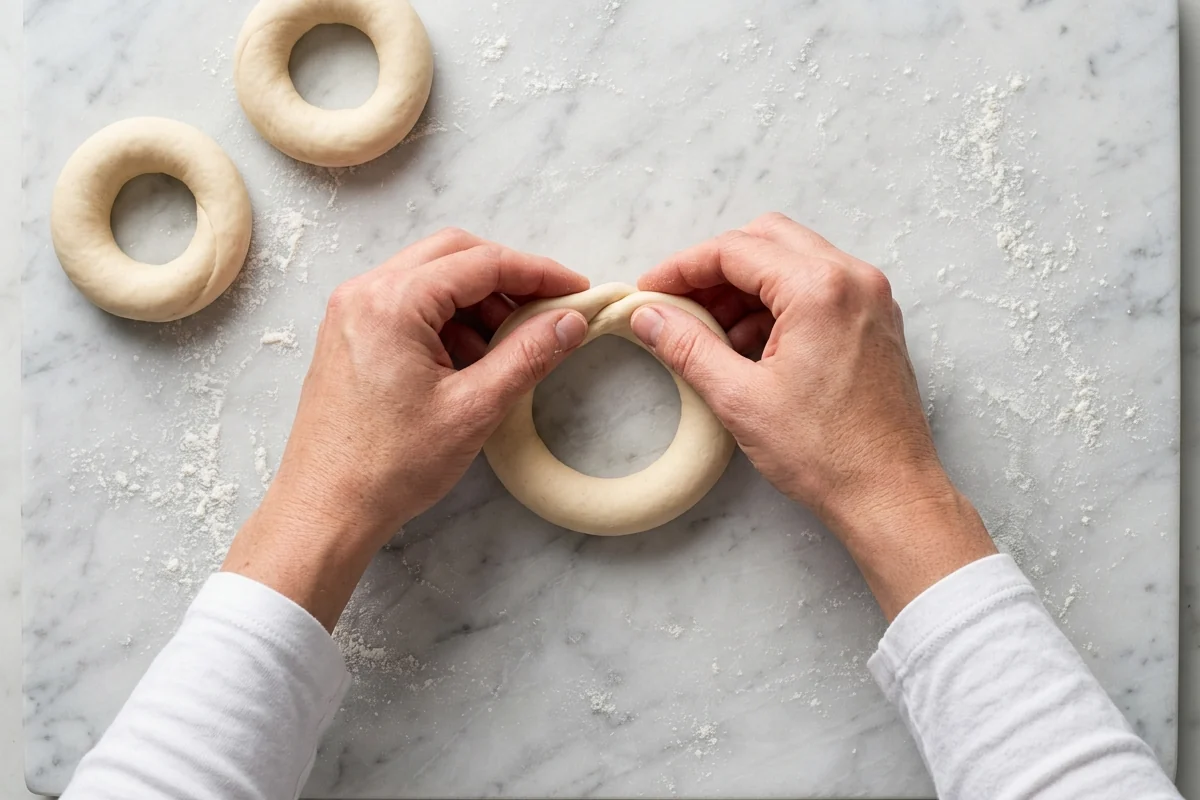
- Shape. Roll each piece into a rope about 8 inches long, wrap it into a ring and pinch the ends together firmly. Pinch harder than feels necessary, because the seam is where they split.
- Wash and top. Brush with beaten egg, then sprinkle generously with seasoning.
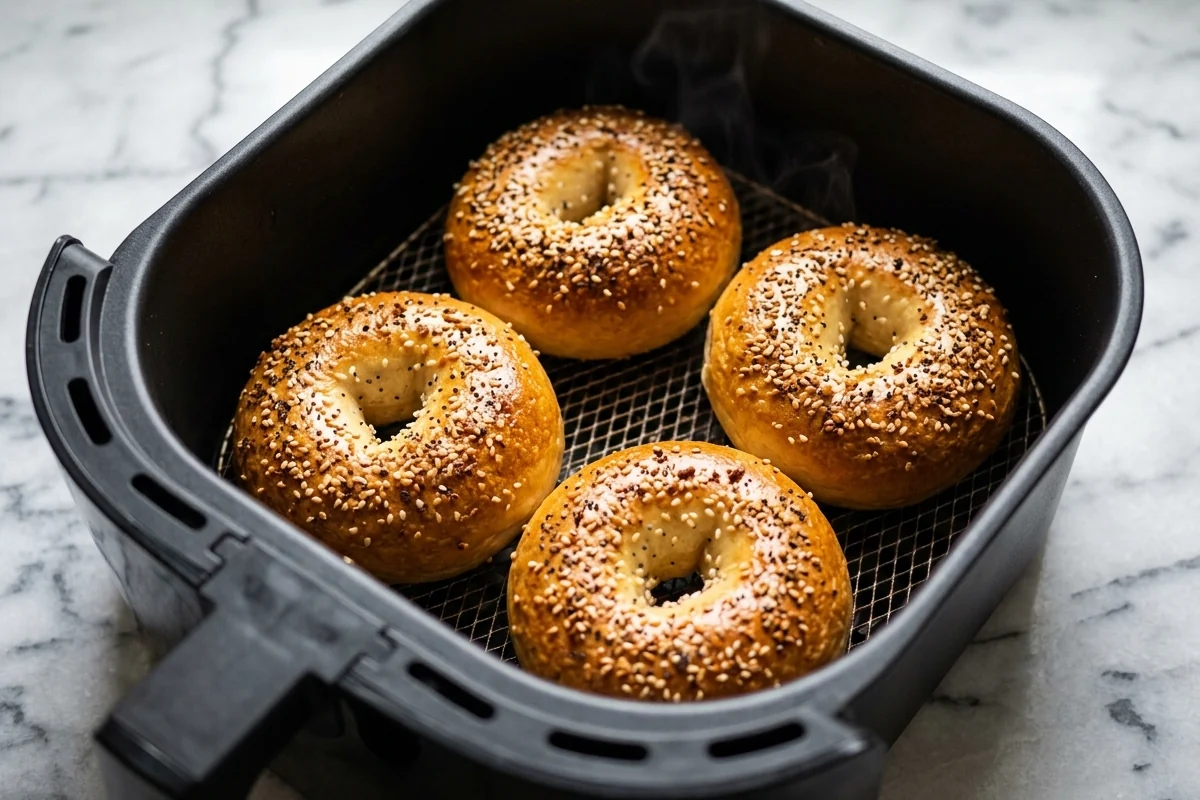
- Bake. Oven: 25 minutes at 375F until deep golden. Air fryer: 12 to 14 minutes at 350F, flipping at the 8 minute mark.
 Save
SaveThe air fryer route is genuinely better here, and not just faster. Specifically, circulating air sets the outside quickly, which gives a crisper skin on a dough that has no boiling step to build one. Flip at 8 minutes or the undersides stay pale. If you want more air fryer baking, our air fryer cottage cheese chips use the same blend-first principle.
 Save
SaveIngredients
Method
- Blend the cottage cheese until completely smooth, 30 to 45 seconds. Stop when no curds are visible.
- Whisk the self-rising flour, whole wheat flour and psyllium husk together in a bowl.
- Pour in the blended cottage cheese and stir with a spatula until it comes together into a shaggy dough.
- Rest 5 minutes. Do not add flour yet, the psyllium is still absorbing water.
- Knead 1 to 2 minutes on a lightly floured surface, just until smooth.
- Divide into 4 equal pieces, roughly 105g each.
- Roll each piece into an 8 inch rope, wrap into a ring and pinch the ends together firmly.
- Brush with beaten egg and sprinkle generously with seasoning.
- Bake at 375F for 25 minutes, or air fry at 350F for 12 to 14 minutes, flipping at 8 minutes.
Notes
Why Is My Cottage Cheese Bagel Dough So Sticky?
Almost always because of whey, not because you measured wrong. 2% cottage cheese is about 81% water by weight (USDA FoodData Central, FDC ID 328841), and brands differ enormously in how much of that water sits loose in the tub rather than bound in the curd. Two cups measured identically can carry very different amounts of free liquid.
Every other recipe tells you to fix this by adding flour a tablespoon at a time. That works, in the sense that the dough stops sticking. It also trades stickiness for density, because you’ve changed the flour-to-cheese ratio the leavening was balanced against. In other words, you get a manageable dough and a heavy bagel.
Strain instead. Tip the cottage cheese into a fine sieve, let it sit 10 minutes, discard what drains, then blend. You’ve removed water without touching the ratio of anything else.
How much drains depends heavily on the brand. Small-curd tubs and those with added cream or stabilisers hold onto their liquid; large-curd and drier styles give up noticeably more. It’s worth doing this once with whatever you buy regularly, since the result tells you how much to expect every time after that.
Wait before you judge the dough. Psyllium husk keeps absorbing water for several minutes after mixing, which is exactly what makes it useful and exactly what makes it confusing. Dough that looks like batter the moment you stir it can be perfectly correct five minutes later. Adding flour at minute zero to a psyllium dough is the most common way to end up with a dense, dry bagel. That’s the whole reason step 4 exists.
Is your dough still slack after resting and straining? Then add flour, a tablespoon at a time, and expect a slightly denser bagel. That’s the correct order of operations, and it’s the reverse of what most recipes suggest.
Variations and Flavor Swaps
The base dough takes flavor well, and the additions go in at step 2 with the dry ingredients.
- Everything: the default. 2 tsp everything seasoning across the four.
- Cinnamon raisin: 1 tsp cinnamon in the dry mix, 1/3 cup raisins kneaded in at step 5. Skip the savory topping.
- Jalapeño cheddar: 1/3 cup sharp cheddar and 1 finely diced jalapeño, both at step 5.
- Garlic herb: 1 tsp garlic powder and 1 tbsp dried chives in the dry mix.
- Sweet: leave the topping off and serve with strawberry cheesecake dip instead of cream cheese.
Going gluten-free? Use a 1:1 gluten-free baking blend in place of both flours, and cut the liquid slightly, since GF blends absorb differently. Expect a denser, more cake-like crumb. Keep the psyllium, which does useful structural work in gluten-free dough.
How Do You Store and Freeze Them?
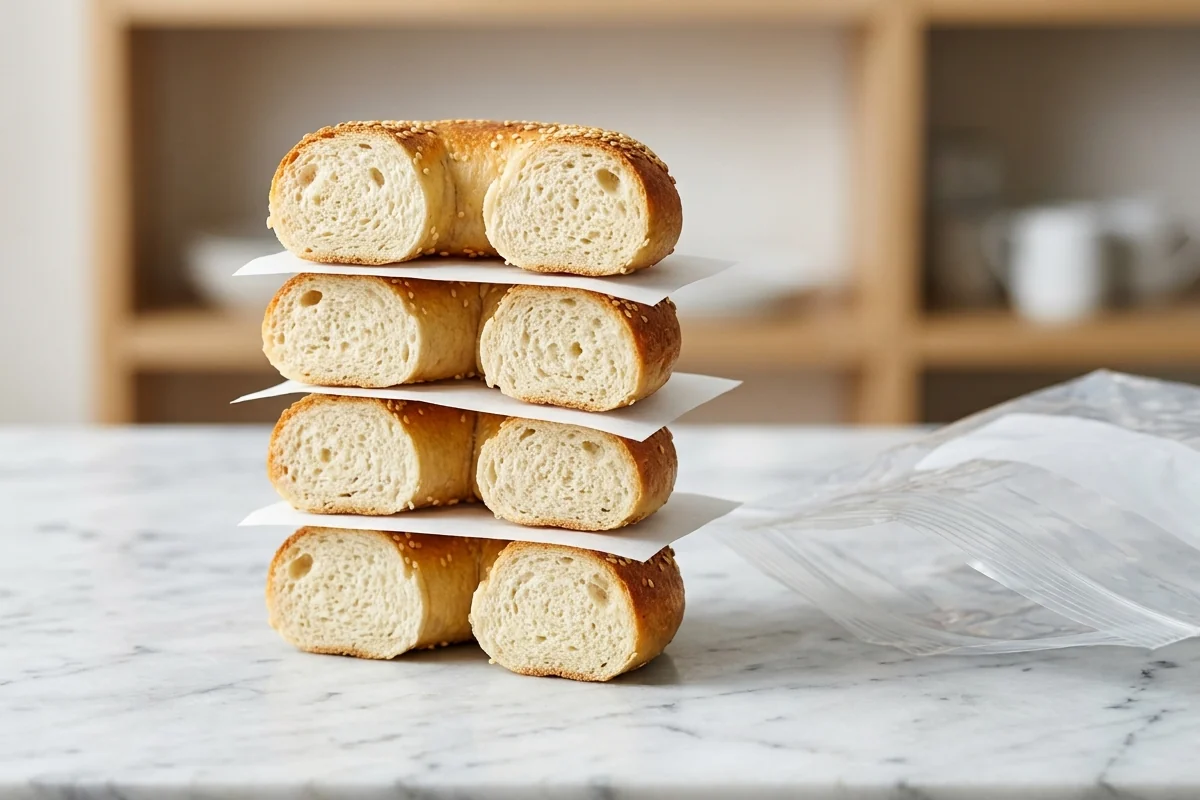
Three days at room temperature in a sealed container, or three months in the freezer. Slice them before freezing, always. A frozen whole bagel is close to impossible to cut safely, and thawing one just to slice it defeats the point.
 Save
SaveStack the halves with a square of parchment between each pair so they don’t fuse. To reheat, go straight from frozen into the air fryer at 350F for 3 to 4 minutes. That beats a toaster comfortably, because a toaster tends to scorch the cut face before the middle thaws.
For a week of breakfasts, double the batch and you’ve got eight bagels in about 45 minutes. It’s the same batching logic behind our high-protein adult lunchables.
What Should You Serve With Cottage Cheese Bagels?
Anything you’d put on a normal bagel works, but a few pairings suit the softer crumb better than others. Because the crumb is more tender than a boiled bagel, heavy spreads compress it and wet toppings soak in faster. Spread and eat rather than building something that sits for twenty minutes, and toast the cut face first if you’re using anything wet.
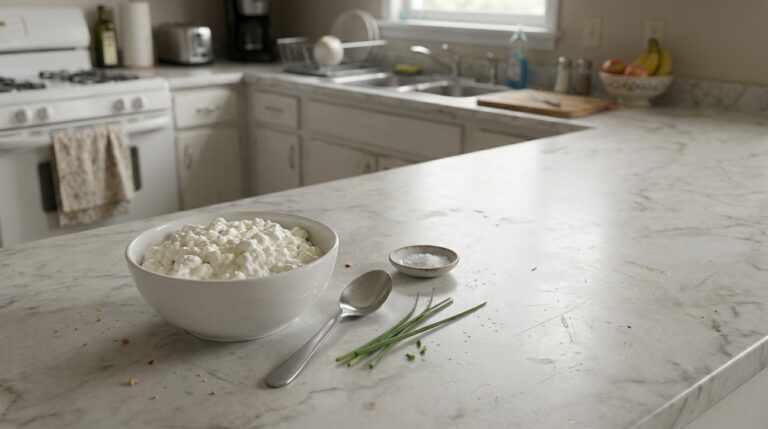
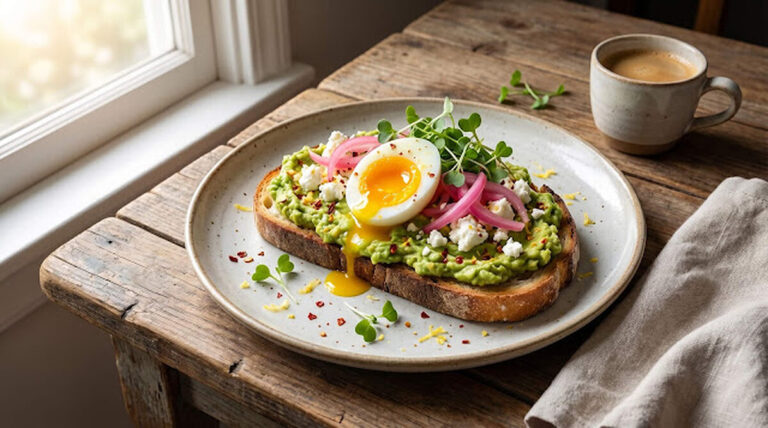
Whipped cottage cheese with a pinch of salt and chives makes an obvious spread, and stacks more protein onto the same plate. Smoked salmon, red onion and capers is the classic and it holds up well here. For something more substantial, mashed avocado with a jammy egg turns one bagel into a full breakfast, which is roughly the build in our avocado egg toast.
If you’re chasing the fiber number rather than the protein one, pair a bagel with a side rather than a spread. A handful of raspberries or a small bowl of edamame will do more for your daily total than anything you can spread on bread. There are more options in our roundup of high-fiber, high-protein snacks.
Frequently Asked Questions
Do I have to blend the cottage cheese?
No, but unblended cottage cheese leaves visible curds and a noticeably wetter dough. Blending for 30 to 45 seconds is what makes the finished bagel read as bread rather than as something baked with cheese in it. It’s the difference between a good result and a strange one.
How much protein is in a cottage cheese bagel?
About 12g per bagel in this version, against 11.1g in a standard 105g plain bagel (USDA FoodData Central, FDC ID 174899). The bigger gain is fiber, at roughly 4.8g against 1.7g. Check your own brand, because protein per cup varies.
Can I use fat-free cottage cheese?
You can, but it’s the most common cause of a gummy crumb. 2% cottage cheese holds about 81% water (USDA FoodData Central, FDC ID 328841), and the small amount of fat is what keeps the texture tender against that moisture. 2% is the sweet spot, and 4% works well too.
Can I make cottage cheese bagels in an air fryer?
Yes, and it’s the better method. 350F for 12 to 14 minutes, flipping at the 8 minute mark. Circulating air crisps the outside faster than an oven, which matters because this dough never gets boiled and has no other way to build a skin.
Are cottage cheese bagels gluten-free?
Not as written, since self-rising flour is wheat. Substitute a 1:1 gluten-free baking blend for both flours and reduce the liquid slightly, as GF blends absorb differently. Keep the psyllium husk, which does real structural work in gluten-free doughs. Expect a denser crumb.
Can you freeze cottage cheese bagels?
Up to three months. Slice them before freezing and stack the halves with parchment between each pair. Reheat straight from frozen in an air fryer at 350F for 3 to 4 minutes, which browns the cut face without scorching it the way a toaster tends to.
The Short Version
These are worth making, with one honest caveat attached.
- Fiber is the real win, not protein. Roughly 4.8g against 1.7g in a plain bagel, close to triple. The protein edge is about 12%, which is real but small.
- The fiber claim is only real if you build it in. Cottage cheese and self-rising flour alone give you almost none. The whole wheat flour and psyllium are the recipe, not an upgrade.
- Strain, don’t flour. Sticky dough is loose whey. Fixing it with flour gets you a dense bagel.
- Wait five minutes before judging the dough. Psyllium is still working.
Made these? Rate the recipe below and tell us which cottage cheese you used, because the brand differences here are bigger than anyone admits.
Next, if you’re working on the fiber side of things, start with fibermaxxing snacks.
Sources
- USDA FoodData Central, Bagels, plain, enriched, with calcium propionate, SR Legacy, FDC ID 174899, retrieved 2026-08-23. https://fdc.nal.usda.gov/
- USDA FoodData Central, Cheese, cottage, lowfat, 2% milkfat, Foundation Foods, FDC ID 328841, retrieved 2026-08-23. https://fdc.nal.usda.gov/
- USDA FoodData Central, Wheat flour, white, all-purpose, self-rising, enriched, SR Legacy, FDC ID 168895, retrieved 2026-08-23. https://fdc.nal.usda.gov/
- USDA FoodData Central, Flour, whole wheat, unenriched, Foundation Foods, FDC ID 790085, retrieved 2026-08-23. https://fdc.nal.usda.gov/
- USDA FoodData Central, Bagels, oat bran, SR Legacy, FDC ID 172666, retrieved 2026-08-23. https://fdc.nal.usda.gov/
- USDA FoodData Central, Egg, whole, raw, fresh, SR Legacy, FDC ID 171287, retrieved 2026-08-23. https://fdc.nal.usda.gov/
- The Insight Partners, Cottage Cheese Market Trends, Size & Forecast by 2034, retrieved 2026-08-23. https://www.theinsightpartners.com/reports/cottage-cheese-market
- Tastewise, Cottage Cheese Trends, retrieved 2026-08-23. https://tastewise.io/blog/cottage-cheese-trends
- Cleveland Clinic, How Much Fiber Do You Need Per Day?, retrieved 2026-08-23. https://health.clevelandclinic.org/how-much-fiber-per-day
- Tufts University, Maxing Out Your Fiber Intake Can Have Broad Health Benefits, October 2025, retrieved 2026-08-23. https://now.tufts.edu/2025/10/30/maxing-out-your-fiber-intake-can-have-broad-health-benefits
- European Journal of Nutrition, The effect of consuming different dietary protein sources at breakfast upon self rated satiety, peptide YY, glucagon like peptide-1, and subsequent food intake in young and older adults, 2025, retrieved 2026-08-23. https://link.springer.com/article/10.1007/s00394-025-03839-y
- News-Medical, High protein breakfasts help you feel fuller but do not change how much you eat later, November 2025, retrieved 2026-08-23. https://www.news-medical.net/news/20251113/High-protein-breakfasts-help-you-feel-fuller-but-do-not-change-how-much-you-eat-later.aspx
Nutrition figures for this recipe are calculated estimates, summed from USDA FoodData Central component data (FDC IDs 328841, 168895, 790085, 171287) plus a label-typical 80% fiber value for psyllium husk. They are not laboratory analysis. Recalculate against the brands you actually use.