
This seafood pasta has shrimp, scallops and mussels tossed with fettuccine and fresh tomatoes in a white wine cream sauce, with a lot of garlic. The wine reduces first, then the cream goes in, so the sauce stays smooth. Each of the 4 servings has about 738 calories and 40.6 g of protein, and it’s on the table in about 40 minutes.
This is my restaurant-night-at-home pasta. It’s for anyone who loves shellfish and garlic and wants a creamy seafood dinner without ordering out, and it’s very yum. It works because the seafood is seared first and set aside, so it stays tender while the sauce reduces in the same pan and picks up all that flavor. And yes, it has a ton of garlic.
Key takeaways
- One serving (a quarter of the pan): about 738 calories and 40.6 g protein, based on USDA FoodData Central. About two-thirds of the protein comes from the seafood.
- Sear the scallops and shrimp first, then take them out. They go back in at the end so they don’t turn rubbery.
- Reduce the wine by half before adding the cream, and keep the sauce at a gentle simmer so it doesn’t split.
- The FDA says shrimp and scallops are done when firm, pearly and opaque, at 145°F.
What Goes Into Seafood Pasta in White Wine Cream Sauce?
Three kinds of shellfish, a pan sauce of garlic, wine, cream and parmesan, and fresh tomatoes for color and a little acid. A garlic white wine cream sauce is one of the best creamy sauces for seafood pasta, because the wine keeps the cream from tasting heavy next to sweet shellfish. Here’s what each part does.
- Shrimp (½ lb). Large shrimp, peeled and deveined. They bring the most protein: half a pound of raw shrimp has about 45.6 g, according to USDA FoodData Central (FDC 175179).
- Scallops (½ lb). Sea scallops cut in half, or small bay scallops. They’re sweet and soft, and they cook in about 3 minutes.
- Mussels (about 12). I use frozen half-shell green mussels, like the ones in my photo. They’re already cooked, so they only need to heat through in the sauce.
- Garlic (8 cloves, or more). A ton of garlic is the point here. Mince it fresh; jarred garlic tastes flat in a cream sauce.
- Dry white wine (½ cup), heavy cream (1 cup) and parmesan (½ cup). The wine adds brightness, the cream makes the sauce, and the parmesan thickens and seasons it.
- Tomatoes (about 1 cup, in chunks). They go in at the end, so they soften but keep their shape.
How Many Calories and How Much Protein Are in It?
One serving, a quarter of the pan, has about 738 calories and 40.6 g of protein, based on USDA FoodData Central’s SR Legacy data (2018). It’s a rich, restaurant-style seafood pasta. Most of the calories come from the pasta, cream and butter, and most of the protein comes from the shellfish.
| Per serving (1 of 4) | Amount |
|---|---|
| Calories | 738 |
| Protein | 40.6 g |
| Fat | 37.3 g (20.3 g saturated) |
| Carbohydrates | 54.6 g |
| Fiber | 2.4 g |
| Sodium | 1,014 mg |
Our finding: the shrimp, scallops and mussels supply about 67% of the protein. The cream and butter together add about 253 calories per serving. Swapping the heavy cream for light cream saves about 86 calories and 7.6 g of saturated fat per serving, but simmer it extra gently, because lighter cream splits more easily.
How to Make Seafood Pasta in White Wine Cream Sauce
- Cook the pasta. Boil the fettuccine 1 minute less than the package says, and save a cup of the pasta water.
- Sear the seafood. Pat the scallops and shrimp dry, sear them in oil and butter, and move them to a plate.
- Garlic, then wine. Soften the garlic in butter, pour in the wine and let it bubble down by half.
- Cream and cheese. Simmer the cream gently until it coats a spoon, then stir in the parmesan.
- Bring it together. Warm the mussels in the sauce, then add the shrimp, scallops, tomatoes and pasta and toss.
The full amounts and times are in the recipe card below.
Which Pan, Pasta, Seafood and Wine Work Best?
- Pan: a 12-inch skillet or wide sauté pan. The seafood needs room to sear in one layer, and the wide surface reduces the wine and cream faster. In a small pan, the shrimp steam instead of browning.
- Pasta: fettuccine or linguine. Flat, wide noodles hold a cream sauce better than spaghetti, which is why this dish is often called seafood fettuccine.
- Scallops: buy “dry” scallops if you can. “Wet” scallops are soaked in a solution that makes them release water, so they boil instead of sear.
- Frozen seafood: it works well. Thaw it overnight in the fridge, or in a sealed bag under cold running water, then pat it very dry.
- Wine: a dry white you’d drink, like pinot grigio or sauvignon blanc. Skip sweet wines, which make the sauce taste sugary.
- Cream: heavy cream is the most forgiving. Half-and-half or light cream works, but it’s more likely to split when it meets the wine and tomatoes.
- Parmesan: grate it from a block. Pre-grated parmesan has anti-caking powder that can make the sauce grainy.
Kitchen note: Take the seafood out of the pan as soon as it’s opaque. It finishes cooking when it goes back into the hot sauce, and a second full cook is what makes shrimp and scallops rubbery.
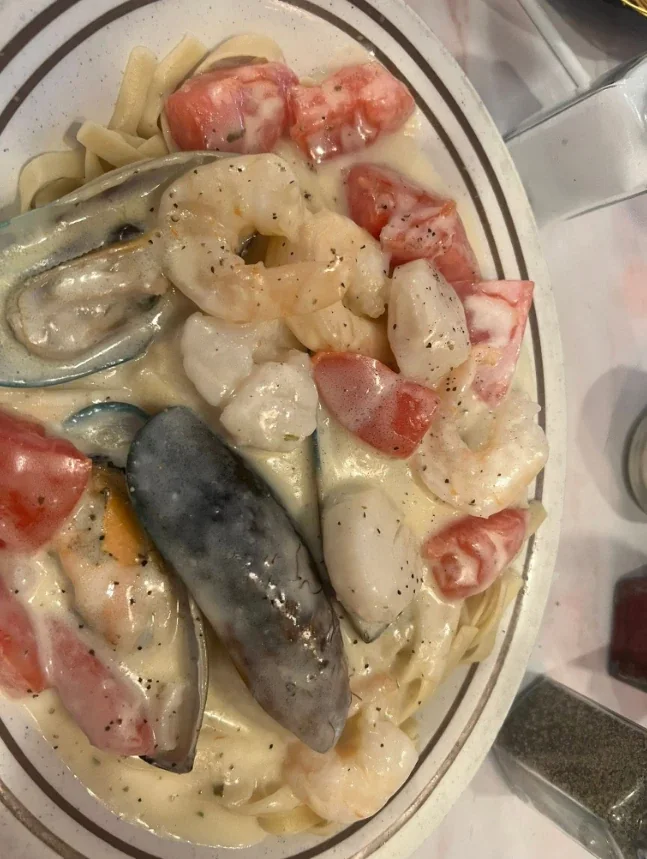
Seafood Pasta in White Wine Cream Sauce
Ingredients
Method
- Bring a large pot of salted water to a boil. Cook the fettuccine 1 minute less than the package says. Save 1 cup of the pasta water, then drain.
- Pat the shrimp and scallops very dry and season with 1/4 tsp salt and the pepper. Heat the olive oil and 1 tbsp butter in a 12-inch skillet over medium-high heat. Sear the scallops for about 2 minutes per side, until golden and opaque, and move them to a plate. Cook the shrimp for 1 to 2 minutes per side, until pink, firm and opaque, and add them to the plate.
- Turn the heat to medium. Add the remaining 1 tbsp butter and the garlic and cook for 30 to 60 seconds, until fragrant but not browned.
- Pour in the wine and scrape up the browned bits. Simmer for 2 to 3 minutes, until reduced by about half.
- Add the cream and simmer gently, without boiling, for 3 to 4 minutes, until it coats the back of a spoon. Lower the heat and stir in the parmesan until melted.
- Add the mussels, cover and heat for 3 to 4 minutes, until hot all the way through.
- Return the shrimp and scallops with their juices. Add the tomatoes, pasta and 1/4 tsp salt and toss for 1 to 2 minutes, adding pasta water a splash at a time if the sauce is too thick. Finish with black pepper and parsley and serve right away.
Notes
What Should It Look and Smell Like at Each Stage?
- Searing the scallops: they sizzle loudly as soon as they hit the pan. After about 2 minutes they release easily, with a golden crust. Turned over, they look milky white and opaque at the sides.
- Shrimp: gray turns pink, and they curl into a loose C. The FDA says shrimp and scallops are done when the flesh is firm, pearly and opaque, at 145°F. A tight O means they’ve gone too far.
- Garlic: after 30 to 60 seconds in the butter, the whole kitchen smells of garlic and the edges just start to turn pale gold. Brown garlic tastes bitter, so add the wine before it gets there.
- Wine: it hisses and loosens the browned bits from the pan. After 2 to 3 minutes it’s down by about half, and the sharp alcohol smell has turned soft and sweet.
- Cream: small, lazy bubbles around the edge, never a rolling boil. After 3 to 4 minutes it coats the back of a spoon, and a finger drawn through it leaves a clean line.
- Mussels: half-shell frozen mussels are hot all the way through after 3 to 4 minutes under the lid. If you use fresh mussels, the shells open as they cook; throw out any that stay closed.
- Done: the sauce clings to every noodle with a glossy sheen, the tomatoes are soft at the edges but still in chunks, and there’s no pool of thin sauce left in the pan.
Why Did My Cream Sauce Split, or Turn Thin?
Most problems with a creamy seafood pasta come from heat. Here’s how to fix them.
- Grainy or split: the cream boiled hard, or the wine didn’t reduce first. Take the pan off the heat, add 2 tablespoons of cream or pasta water and whisk. It often comes back together.
- Thin and watery: the seafood or tomatoes released liquid. Simmer a minute or two longer, or stir in a little more parmesan.
- Too thick or tight: cream sauce firms up as it sits. Loosen it with a splash of the saved pasta water.
- Rubbery shrimp or scallops: they cooked too long. Next time, pull them out the moment they turn opaque.
- Gritty bites: fresh mussels need a scrub and their beards pulled off before cooking. Half-shell frozen mussels skip this step.
Want another creamy dinner? Try our cottage cheese lasagna. For a lighter seafood night, our air fryer salmon takes 15 minutes, and our garlic butter sauce is great on leftover shrimp.
Frequently Asked Questions
Can you mix white wine and cream in a sauce?
Yes. Simmer the wine for 2 to 3 minutes, until it’s reduced by about half, then add the cream and keep it at a gentle simmer for 3 to 4 minutes. Reducing cooks off the sharp alcohol and some of the acid, which is what can make cream curdle.
Can I make it without wine?
Yes. Use ½ cup of chicken or seafood broth plus 1 tablespoon of lemon juice in place of the wine. The sauce is a little less bright, but still very good.
How long do leftovers keep, and can I freeze it?
Refrigerate leftovers within 2 hours and eat them within 3 to 4 days, the USDA’s guideline for leftovers. Reheat gently on the stove with a splash of milk or pasta water. I wouldn’t freeze it: cream sauce tends to separate when thawed, and the seafood turns tough.
Sources
- U.S. Department of Agriculture, FoodData Central, SR Legacy, FDC IDs 169736 (dry pasta), 175179 (shrimp, raw), 174220 (scallops, raw), 174217 (mussels, cooked), 170859 (heavy cream), 174837 (white wine), 173410 (butter), 171413 (olive oil), 169230 (garlic), 171247 (grated parmesan), 170457 (tomatoes), 173468 (salt), 170857 (light cream), retrieved 2026-11-19, fdc.nal.usda.gov
- U.S. Food and Drug Administration, Selecting and Serving Fresh and Frozen Seafood Safely, retrieved 2026-11-19, fda.gov
- USDA Food Safety and Inspection Service, Leftovers and Food Safety, retrieved 2026-11-19, fsis.usda.gov
