
Does Cooking Spinach Kill Cyclospora? How to Wash Leafy Greens Safely
 Save
SaveYou rinse your spinach, spin it dry, and toss it into a bowl feeling safe. But here’s the uncomfortable truth: washing can lower your risk from a parasite like Cyclospora, yet it can’t wash the threat away completely. The 2026 Cyclospora outbreak, traced to Taylor Farms iceberg lettuce, sickened 12,883 people in 21 states, hospitalized 570, and caused 2 deaths before the CDC declared it over (CDC, Cyclospora outbreak 07-26, Sept. 2026). So how do you actually protect yourself at the sink? This guide walks you through the science, the step-by-step method, and the myths to skip.
Does Cooking Spinach Kill Cyclospora?
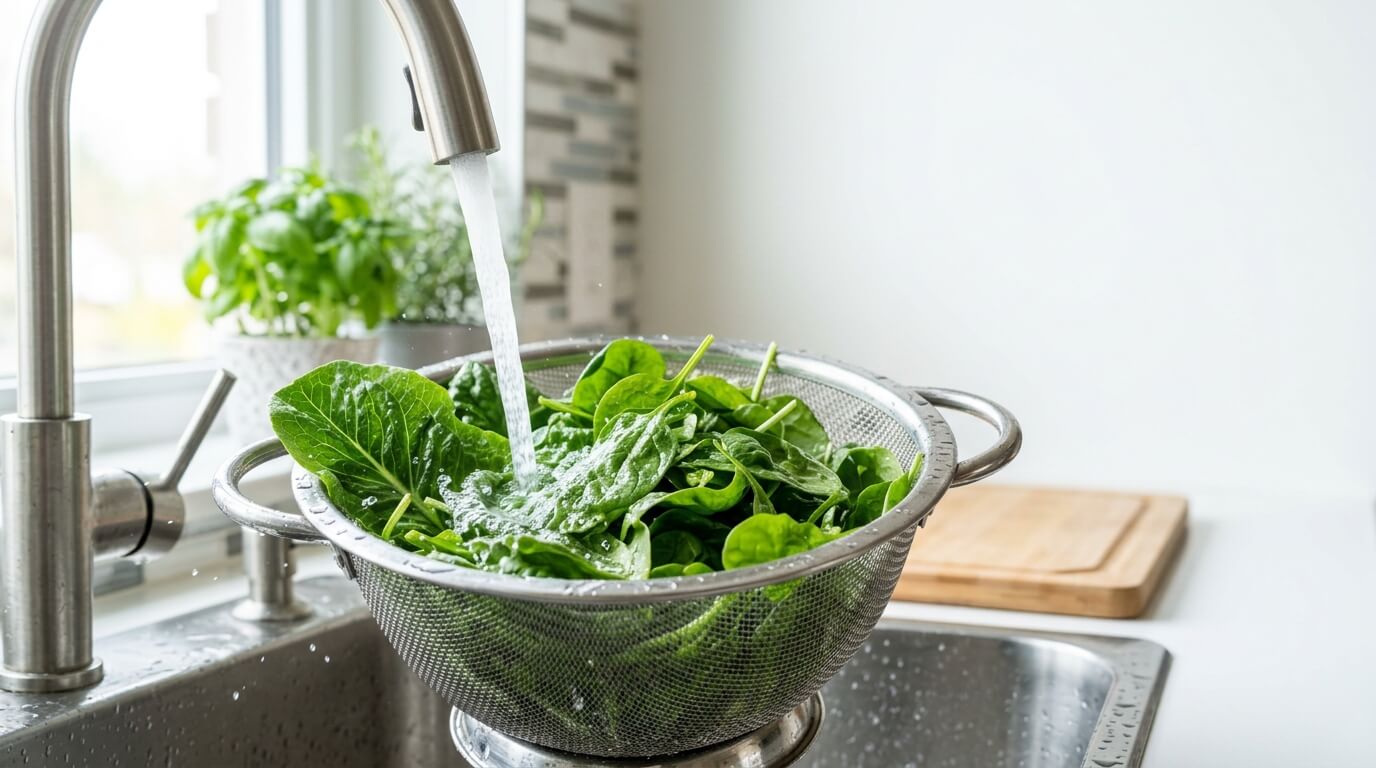
Yes. Cooking kills the Cyclospora parasite, and the CDC says to cook produce to at least 158°F (70°C) (CDC, “Preventing Cyclosporiasis”, 2026). Sautéing, boiling, or baking spinach until it is fully wilted and steaming hot gets it there. Rinsing under cold running water lowers your risk but cannot remove the parasite completely, and no home wash, vinegar soak, or produce spray reliably kills it.
Key Takeaways
- Cooking to at least 158°F (70°C) kills Cyclospora; washing only lowers the risk (CDC, 2026).
- The 2026 outbreak, linked to iceberg lettuce, reached 12,883 cases in 21 states and is now over (CDC, Sept. 2026).
- Rinsing reduces your risk but can’t remove Cyclospora’s tough oocyst shell; thorough cooking is the only sure way to destroy it.
- Use cold running water, never soap, bleach, or produce wash, which the FDA warns can be absorbed and make you sick.
- Don’t re-wash bagged greens labeled “ready-to-eat”; extra handling adds contamination risk, not safety.
Can You Actually Wash Cyclospora Off Your Salad?
No, not completely. During the 2026 outbreak, the CDC tallied 12,883 cases across 21 states, and its prevention guidance is blunt: rinsing produce can lower your risk but does not eliminate it (CDC, “Preventing Cyclosporiasis”, 2026). The parasite hides inside a tough, sticky shell called an oocyst that clings to microscopic crevices on leaves and won’t rinse free.
Why does that shell matter so much? Cyclospora’s oocyst is built to survive. The chlorine washes and antimicrobial rinses that knock down bacteria simply don’t neutralize it. That’s the part most salad-safety advice gets wrong, it treats washing as a cure when it’s really just damage control.
According to the FDA and CDC, washing produce with water does not reliably remove or kill Cyclospora, because the parasite’s oocyst resists standard sanitizers and chlorine treatments. Thorough cooking is the only method proven to destroy it. Rinsing still helps by reducing the parasite load, so it remains a worthwhile first step (FDA, 2026).
The takeaway isn’t “give up on washing.” It’s to wash correctly and understand its limits. For raw greens, careful rinsing is your best available defense. When an outbreak is active, cooking becomes the safer play.
Related: Browse our fresh salad recipes, the raw dishes where safe washing matters most.
Why Doesn’t Rinsing Remove Every Pathogen?
Because leaves are far from smooth. In a peer-reviewed household-washing study, even a strong tap flow of 8 liters per minute failed to significantly reduce harmful E. coli on lettuce, though it cut total aerobic bacteria by 80% (Food Science & Nutrition, 2017). Pathogens don’t just sit on the surface waiting to be rinsed off.
Three things work against your faucet. First, bacteria and parasites lodge in the natural pores and folds of the leaf. Second, some microbes form biofilms, sticky microbial glue that anchors them in place. Third, contamination can happen inside the plant, drawn up through the roots as it grows, where no rinse can reach.
Commercial processing isn’t a magic fix either. One study found that commercial washing of leafy vegetables didn’t significantly cut the total bacterial load, it just shifted which species were present (ScienceDirect, 2021). That’s exactly why pre-washed bags still occasionally get recalled.
Related: Our meal-prep and storage guide helps you keep greens fresh longer.
How Do You Wash Leafy Greens Properly, Step by Step?
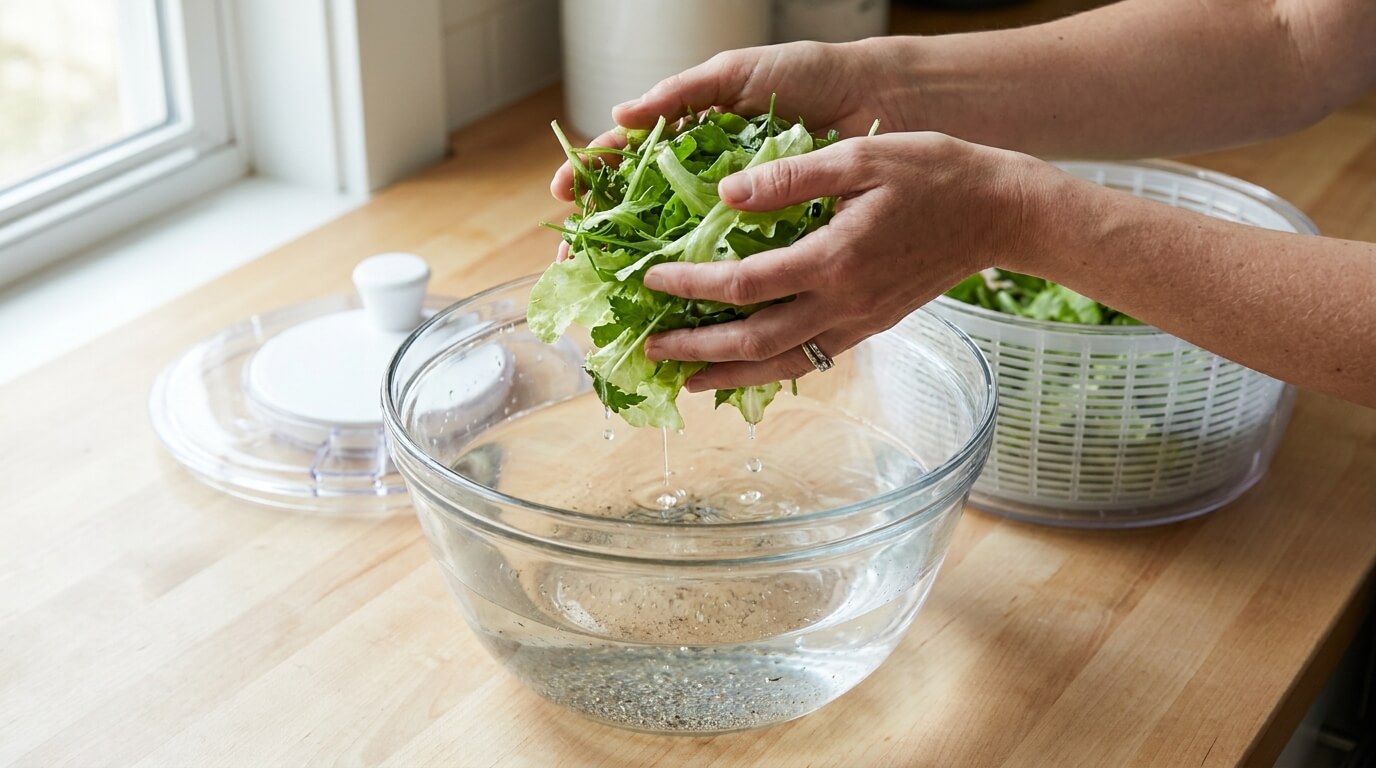
Start with cold running water and skip every additive. The FDA’s official guidance is to gently rub produce under cold, running tap water with no soap, produce wash, or bleach (FDA, “7 Tips for Cleaning Fruits & Vegetables”, 2026). For loose leafy greens, the soak-and-lift method removes the most grit and surface microbes.
 Save
SaveHere’s the method I use every time I prep a big batch of salad for the week:
- Wash your hands and prep surface first. Twenty seconds of soap and water on your hands, plus a clean cutting board. Cross-contamination often starts before the greens hit the water.
- Discard the outer leaves. The FDA recommends removing the outermost leaves of a head of lettuce or cabbage, they’re the most exposed and most handled.
- Soak in a big bowl of cold water. Submerge the leaves fully and swish gently. Grit and sand sink; debris floats.
- Lift, don’t pour. Scoop the greens out of the water rather than draining through them. Pouring drags settled grit right back onto the leaves.
- Repeat with fresh water until the bottom of the bowl is clean, usually two rounds for gritty spinach or garden lettuce.
- Dry thoroughly. Spin in a salad spinner or pat with a clean paper towel. The FDA notes that drying further reduces bacteria, and dry leaves also keep dressings clinging where they should.
Does the salad spinner really matter? More than you’d think. Damp greens breed bacteria faster in the fridge and dilute your dressing. In our test kitchen, spun-dry greens stayed crisp two to three days longer than greens left wet, a small step with an outsized payoff.
Related: Put clean greens to work in our chickpea salad or tuna avocado salad.
What Should You Never Do When Washing Greens?
Never reach for soap, bleach, or a “veggie wash.” The FDA explicitly warns that soap and household detergents can be absorbed by produce despite rinsing and can make you sick, and it advises against bleach, sanitizer, alcohol, or any chemical (FDA, “7 Tips for Cleaning Fruits & Vegetables”, 2026). Plain cold water does the job water can do; nothing at the sink kills Cyclospora.
A few more traps to avoid:
- Don’t re-wash “ready-to-eat” bagged greens. If the package says pre-washed, rinsing again adds handling and contamination risk without a safety benefit, per FDA guidance.
- Don’t trust a vinegar soak as a cure. Vinegar isn’t proven to kill Cyclospora. Texas health officials confirmed in 2026 that neither vinegar nor produce washes reliably remove the parasite, only cooking does (CBS News Texas, 2026).
- Don’t let clean greens touch dirty surfaces. Washed produce that lands on the same board you used for raw chicken is no longer clean.
A 2026 statement from the FDA and CDC confirmed that vinegar rinses, chlorine dips, and commercial produce washes do not reliably kill Cyclospora, whose oocyst shell resists standard sanitizers. Consumers who want certainty during an active outbreak should cook leafy greens and herbs thoroughly, since heat is the only method proven to destroy the parasite.
This article is for general education. See our full disclaimer, and talk to a doctor about any medical concern.
Which Greens and Recipes Carry the Most Risk?
Leafy greens top the produce-risk list, and lettuce leads the pack. A 2024 analysis in the Journal of Food Protection estimated leafy greens cause up to 2.3 million foodborne illnesses a year in the U.S., costing as much as $5.3 billion, and lettuce alone accounts for roughly 75.7% of leafy-green illnesses (Journal of Food Protection, 2024). Raw, delicate, and heavily handled greens are the usual culprits.
For Cyclospora specifically, the historical hot list is telling: leafy greens, cilantro, basil, and imported fresh herbs. That has direct recipe implications. A cilantro-heavy raw salsa, a basil pesto that never sees heat, or a raw green smoothie all skip the one step that guarantees safety. Which of your go-to recipes are 100% raw? Those are the ones to rethink first when an outbreak is active.
Here’s how common kitchen methods actually stack up against the parasite:
| Method | Effect on Cyclospora | Effect on bacteria |
|---|---|---|
| Cold-water rinse (soak & lift) | Reduces risk; can’t remove oocyst | Modest reduction |
| Soap or detergent | Not recommended (can be absorbed) | Not advised |
| Vinegar soak | Not proven to kill | Minimal |
| Chlorine / produce wash | Largely ineffective | Some reduction |
| Thorough cooking (heat) | Destroys the oocyst | Kills bacteria |
Related: Air fryer roasted vegetables are an easy way to serve greens and veggies cooked.
Should You Cook Greens During an Active Outbreak?
If you want certainty, yes. Because heat is the only method proven to destroy Cyclospora, cooking food thoroughly is the single reliable way to eliminate the parasite, rinsing only reduces the risk (CDC, “Preventing Cyclosporiasis”, 2026). During the 2026 outbreak, that’s the guidance public-health officials repeated most.
 Save
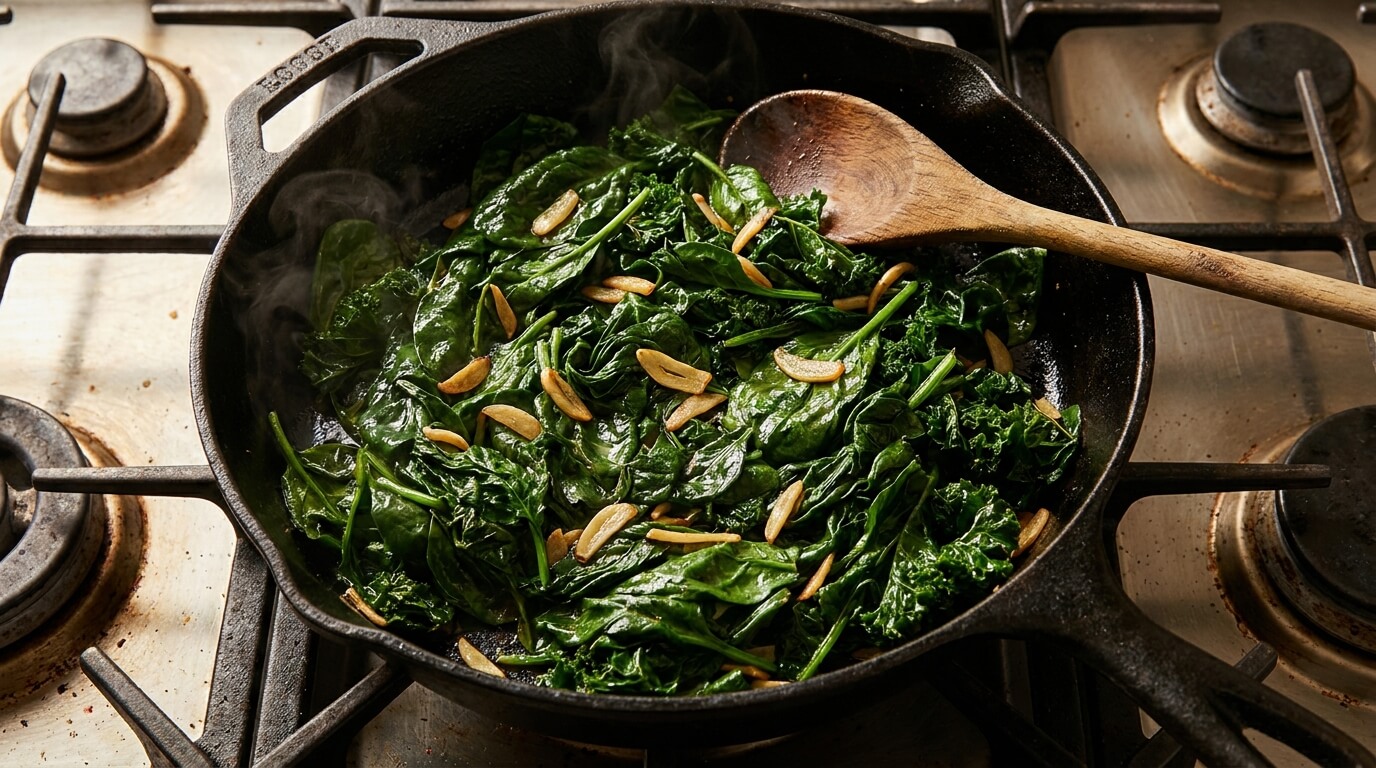
SaveYou don’t have to give up greens, just pivot how you serve them. Wilt spinach into a morning scramble. Sauté kale with garlic. Blister romaine on the grill for a warm Caesar. Fold cooked greens into a frittata or a high-protein grain bowl. The flavor payoff is real, and the safety upgrade is total.
Our take: During the 2026 alert, we quietly swapped several raw-salad features on FlavorFlip for warm, sautéed-greens versions, same nutrition story, no raw-produce risk. Cooked greens photograph beautifully and reheat well for meal prep, so it’s a swap worth keeping even after an outbreak passes.
Who should be most cautious? Anyone serving young kids, older adults, pregnant people, or anyone immunocompromised should lean toward cooked greens whenever an outbreak is active. For them, “reduce the risk” isn’t good enough, “eliminate it” is the goal.
Related: Quick cooked-veggie sides like air fryer asparagus and crispy air fryer veggies.
Protect Yourself Without Giving Up Fresh Greens
Fresh greens are one of the best things you can eat, don’t let a parasite scare push them off your plate for good. Wash smart, dry well, keep raw and cooked separate, and cook your greens whenever an outbreak is active or someone vulnerable is at the table. That combination gives you the biggest risk reduction the kitchen can offer.
Want more no-stress food-safety tips and recipes built around them? Explore more tested FlavorFlip recipes, including plenty that put your greens safely over heat.
Frequently Asked Questions
Does cooking spinach kill Cyclospora?
Yes. Thorough cooking is the one method proven to destroy Cyclospora, heat inactivates the parasite that washing, vinegar rinses, and produce sprays leave behind. Cook to at least 158°F (70°C): bring spinach and other greens to a fully wilted, steaming-hot state (sautéed, boiled, or baked until piping hot) rather than a quick warm-through. During an active outbreak, cooking suspect greens is the safest option; rinsing lowers risk but cannot remove Cyclospora completely (CDC, 2026).
Is spinach safe to eat during a Cyclospora outbreak?
Cooked spinach is safe; raw spinach is a calculated risk. Because heat destroys Cyclospora, cooked spinach is safe to eat even during an outbreak. For raw spinach, rinse thoroughly under cold running water and dry it well, this lowers but does not eliminate the risk. If you are pregnant, older, or immunocompromised, favor cooked greens while an outbreak is active (CDC, 2026).
Does vinegar or lemon juice kill Cyclospora?
No. In 2026, Texas health officials confirmed that vinegar soaks and produce washes do not reliably kill or remove Cyclospora (CBS News Texas, 2026). The parasite’s oocyst shell resists acids and sanitizers alike. Only thorough cooking is proven to destroy it, so heat, not a vinegar rinse, is your reliable safeguard.
Are pre-washed bagged salads safe to eat without rinsing?
Generally yes, and re-washing can backfire. The FDA says produce labeled “pre-washed” or “ready-to-eat” needs no further washing, and extra handling can add contamination (FDA, 2026). That said, bagged greens have been recalled before, so check for recall notices and skip any bag past its use-by date or with slimy leaves.
Do I really need a salad spinner?
It helps more than it seems. The FDA recommends drying produce because it further reduces bacteria left after rinsing (FDA, 2026). A spinner also keeps greens crisp longer and helps dressing cling. No spinner? A clean paper towel or dish cloth does the same job with a gentle pat.
How soon do Cyclospora symptoms appear?
Usually about a week after exposure. Cyclosporiasis typically brings watery diarrhea, cramping, appetite loss, and fatigue that can last weeks without treatment (CDC, 2026). Unlike many foodborne bugs, it’s a parasite, so it often needs specific antibiotics, see a doctor if symptoms persist, especially prolonged or explosive diarrhea.
Does freezing kill parasites on greens?
Not reliably for Cyclospora. Home freezers don’t guarantee destruction of the oocyst, and freezing ruins the texture of leafy greens anyway. Thorough cooking remains the only method health authorities endorse for eliminating the parasite (CDC, 2026). For raw greens, careful washing to reduce risk is the best you can do.
The Bottom Line
- Washing leafy greens reduces parasite and bacteria risk but never removes Cyclospora completely, its oocyst shell survives rinsing and sanitizers.
- Use the cold-water soak-and-lift method, dry thoroughly, and never use soap, bleach, or produce wash.
- When an outbreak is active or you’re feeding someone vulnerable, cook your greens, heat is the only proven way to destroy the parasite.
Small habits at the sink add up to real protection. Start with your next batch of greens, and when in doubt, turn on the heat.
Related: Browse our side-dish recipes for more warm, veggie-forward ideas.
Sources
- CDC, “Preventing Cyclosporiasis,” retrieved 2026-07-11, cdc.gov
- CDC, “Cyclospora outbreak linked to iceberg lettuce (07-26),” retrieved 2026-09-30, cdc.gov
- FDA, “7 Tips for Cleaning Fruits & Vegetables,” retrieved 2026-07-11, fda.gov
- FDA, “Selecting and Serving Produce Safely,” retrieved 2026-07-11, fda.gov
- Food Science & Nutrition, “Effects of household washing on bacterial load and removal of E. coli from lettuce,” retrieved 2026-07-11, ncbi.nlm.nih.gov
- ScienceDirect, “Commercial wash of leafy vegetables does not significantly decrease bacterial load,” retrieved 2026-07-11, sciencedirect.com
- Journal of Food Protection, “Foodborne Illnesses from Leafy Greens in the United States: Attribution, Burden, and Cost,” retrieved 2026-07-11, sciencedirect.com
- CBS News Texas, “Does cooking or vinegar kill Cyclospora?,” retrieved 2026-07-11, cbsnews.com