

Crustless cottage cheese pumpkin pie is a blender dessert that swaps the evaporated milk in a classic filling for cottage cheese and leaves the pastry out. Each of the 8 slices has about 140 calories and 7.6 g of protein, with no protein powder, and the whole thing goes from blender to oven in 10 minutes.
It still eats like Thanksgiving: spiced, sliceable and cold from the fridge. The honest trade-off is the one you’d expect. There’s no crust, so there’s no flaky edge. Every number below is worked out from USDA data, and the arithmetic is on the page so you can check it.
Key takeaways
- One slice: about 140 calories and 7.6 g protein, from USDA FoodData Central values.
- A commercial slice runs 323 calories and 5.2 g protein.
- Blend the cottage cheese alone first.
- Pull the pie at 175°F, then chill it at least 4 hours.
I wanted a pumpkin pie I could have a slice of any night in November, not just on Thanksgiving, without it taking a third of my day's calories. This one is for anyone counting protein or calories, or skipping gluten, who still wants something that tastes like the real holiday pie. It works because blended cottage cheese takes the place of evaporated milk, and pulling it out of the oven at 175°F keeps the custard smooth instead of rubbery.
About This Cottage Cheese Pumpkin Pie
It’s a baked pumpkin custard set in a pie plate, with blended cottage cheese doing the job dairy usually does. Many classic fillings use a can of pumpkin, two eggs and a can of evaporated milk. This one keeps the pumpkin, adds a third egg, and replaces the milk with 1½ cups of cottage cheese.
That single swap accounts for most of the protein. Cottage cheese supplies 37.4 g of the 61 g in the pie, which is 61% of the total. Once blended, the curds disappear, so you get a smooth custard with no cheesy texture. If you like this idea, our cottage cheese recipes use the same trick from breakfast through dessert.
Calories and Protein per Slice
One slice, an eighth of the pie, has about 140 calories and 7.6 g of protein, calculated from USDA FoodData Central values. The whole pie comes to 1,122 calories and 61 g of protein. Here’s where those numbers come from.
| Ingredient | Amount | Calories | Protein | Sugars |
|---|---|---|---|---|
| Cottage cheese, 2% | 340 g | 286 | 37.4 g | 13.9 g |
| Pumpkin, canned | 425 g | 145 | 4.7 g | 14.0 g |
| Eggs, 3 large | 150 g | 215 | 18.8 g | 0.6 g |
| Maple syrup | 160 g | 416 | 0.1 g | 96.7 g |
| Cornstarch | 16 g | 61 | 0 g | 0 g |
| Whole pie | 1,122 | 61.0 g | 125.2 g | |
| Per slice (1/8) | 140 | 7.6 g | 15.6 g |
Spice and vanilla aren’t counted, because together they add very little. A slice also carries 21.5 g carbohydrate, 2.9 g fat, 1.6 g fiber and 168 mg sodium.
Is that “high protein”? Not by the label definition. The FDA’s Daily Value for protein is 50 g, so 7.6 g is about 15%. On raw grams, that sits in the 10 to 19% band federal rules call a “good source”, below the 20% needed for “high” (21 CFR 101.54). For a slice of pie, that’s still a good result, but we’d rather call it what it is.
Versus a Classic Pumpkin Pie
A slice of commercially prepared pumpkin pie weighs 133 g in USDA’s records and has 323 calories and 5.2 g of protein (USDA FoodData Central, FDC ID 172787). This crustless version has less than half the calories and about 1.5 times the protein.

| Per slice | Commercial pumpkin pie (133 g) | This crustless pie (1/8) |
|---|---|---|
| Calories | 323 | 140 |
| Protein | 5.2 g | 7.6 g |
| Fat | 13.0 g | 2.9 g |
| Total sugars | 25.1 g | 15.6 g |
| Sodium | 318 mg | 168 mg |
| Fiber | 2.4 g | 1.6 g |
| Vitamin A | 596 µg RAE | 473 µg RAE |
Two caveats keep this comparison fair. The classic pie wins on fiber and vitamin A, partly because its slice is a solid 133 g. And an eighth of this pie starts as about 137 g of batter, then loses some water in the oven, so the finished slice will weigh a little less. Pumpkin still does its job here: a slice gives 473 µg of vitamin A, or about 53% of the 900 µg Daily Value.
It’s also still dessert. The maple syrup puts about 12 g of added sugar in each slice, which is 24% of the 50 g Daily Value.
What Each Ingredient Does
Five ingredients carry this pie, and each one has a specific job. Cottage cheese brings the protein and creaminess, eggs set the custard, and cornstarch protects it from cracking. Understanding those jobs tells you which swaps are safe.
Cottage cheese, 2%
Use 2% or full-fat. The fat rounds out the spice, and fat-free versions tend to be wetter. There’s no salt in this recipe on purpose, because the cottage cheese alone adds 1,091 mg, or 81% of the pie’s sodium. Watching your intake? A low-sodium cottage cheese cuts that sharply, though you may want a pinch of salt for flavor.
Pumpkin puree
Check the can. You want 100% pumpkin, not pumpkin pie filling, which is already sweetened and spiced. Pumpkin brings the color, the flavor and nearly all of the 12.3 g of fiber in the pie. It adds only 4.7 g of protein, so it isn’t where the protein comes from.
Eggs and cornstarch
Eggs are what turn this mixture into a sliceable custard. A crust usually gives a pie some support, so the third egg helps the filling hold its shape alone. Cornstarch adds a safety margin: starch helps keep egg proteins from tightening too hard, which makes curdling and cracking less likely.
Maple syrup
Maple is the only added sweetener, and it suits pumpkin. Want it less sweet? Dropping to ⅓ cup (105 g) takes each slice to about 122 calories and 11.5 g of total sugars.
How to Make Crustless Cottage Cheese Pumpkin Pie
Blend the cottage cheese until completely smooth, blend in everything else, and bake at 350°F for 45 to 55 minutes until the center reaches 175°F. It takes 10 minutes of hands-on work, about 50 in the oven and at least 4 hours in the fridge.
Tools and Ingredient Notes
- 2% vs 4% cottage cheese: The recipe is built on 2% (the numbers on the card use it). Full-fat 4% makes a slightly richer, softer custard and adds a few calories per slice. Both set fine at 175°F. Skip fat-free.
- Pie plate size: This filling is sized for a 9.5-inch deep-dish plate. A standard 9-inch plate will be very full. Leave a half-inch gap at the top and bake the extra batter in a greased ramekin (it'll be done in about 20 to 25 minutes).
- Glass vs metal: Glass and ceramic heat more slowly, so start checking at 50 minutes. A metal pie tin can be done at 45. Either way, the thermometer is what decides.
- Blender: A full-size blender is easiest because the batter fills about 5 cups. In a smaller blender, blend the cottage cheese alone first, then add the rest in two batches and whisk them together in a bowl.
- Thermometer: An instant-read thermometer is the most useful tool for this pie. Push it into the very center, about halfway down.
- Canned pumpkin: Brands differ in thickness. A thick, dense puree holds up well. If your can looks loose or watery, blot it on paper towels for a few minutes before measuring.
- Spice: Pumpkin pie spice that's been in the cupboard for over a year tastes dusty and you'll notice it here, because there's no crust or cream to fill out the flavor. Use a fresh jar, or mix 1 1/4 tsp cinnamon, 1/2 tsp ginger, 1/4 tsp nutmeg and a pinch of cloves. I like mine heavily spiced, so I add more than the card lists. Treat the card as a starting point and season to your own taste, going up 1/2 teaspoon at a time between bakes.
- Cornstarch, not flour: Cornstarch keeps the pie gluten-free and makes a smoother set. Flour works in a pinch at double the amount, but the custard comes out slightly pasty and isn't gluten-free anymore.
Kitchen note: Watch the moisture: wet pumpkin or loose cottage cheese leaves the center soft. Let the pie cool completely before slicing so it sets.

Crustless Cottage Cheese Pumpkin Pie
Ingredients
Method
- Heat the oven to 350F (175C). Grease a 9.5-inch deep-dish pie plate well, including the sides. With no crust, the filling sits directly on the dish.
- Blend the cottage cheese alone on high for 60 seconds, scraping down once, until no white specks remain on the side of the jar.
- Add the pumpkin, eggs, maple syrup, cornstarch, spice and vanilla. Blend for 20 to 30 seconds, only until smooth. Tap the jar on the counter a few times to release air bubbles.
- Pour into the prepared dish and bake on the middle rack for 45 to 55 minutes. Start checking at 45 minutes.
- The pie is done at 175F (79C) in the center. The edges will look set and the middle will still wobble slightly when nudged. Remove it now, because custard keeps cooking as it cools.
- Cool on a wire rack for up to 1 hour, then refrigerate uncovered. It needs to be in the fridge within 2 hours of leaving the oven. Cover once cold.
- Chill for at least 4 hours. Slice with a thin, sharp knife, wiping the blade between cuts.
Notes
What to Look For at Each Stage
- Blending the cottage cheese alone: At first it looks lumpy and wet, like cottage cheese thinned with milk. Around 40 to 60 seconds it turns glossy and thick, like sour cream, and the sound of the blender gets smoother and lower. Check the sides of the jar: no white specks means it's ready.
- The finished batter: A smooth, even orange-brown, with the spice spread through and no streaks. It should pour off a spoon in a thick ribbon. Tapping the jar brings up small bubbles. Pop any big ones on the surface with a toothpick after pouring.
- Around 30 to 35 minutes: The kitchen fills with the smell of the spice and the outer inch of the pie looks set and matte, while the center is still shiny and liquid.
- Done (45 to 55 minutes): The edges have puffed slightly and pulled just a little away from the dish, and the surface is matte all the way across. Nudge the dish: the center should jiggle like set gelatin, moving as one piece, not rippling like liquid. The thermometer should read 175°F. A skewer in the center comes out clean.
- Overbaked signs: The center puffs up like a soufflé or cracks start at the edges. Pull it right away.
- After chilling: The puff settles flat and the color darkens slightly. A cold slice should cut with clean, straight sides and feel dense and creamy, like cheesecake, not spongy.
Signs It's Done
Use a thermometer: pumpkin pie is done at 175°F in the center, according to Iowa State University Extension. That’s comfortably above the 160°F that FoodSafety.gov sets for egg dishes. Without a thermometer, a skewer in the center should come out clean, while the middle still wobbles a little.

Don’t wait for a firm center. Custard keeps cooking as it cools, so a pie that looks fully set in the oven is usually overdone by the time it’s cold. Ovens and dishes vary, which is why the bake time is a range. Glass and ceramic plates can run a few minutes slower than metal.
Why Did My Pie Crack, Weep or Taste Cheesy?
Most problems with this pie come down to three things: too much heat, too little blending or too little chilling. Pulling it at 175°F prevents the most common one. Here’s how to read what you see.
The top cracked
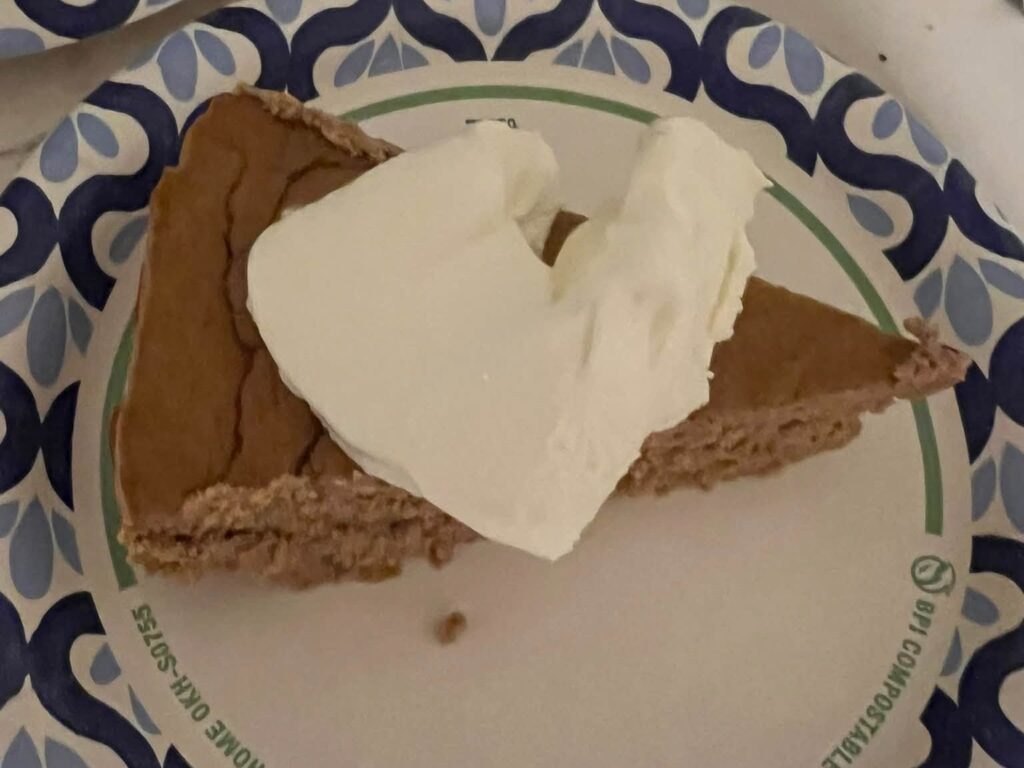
It went too hot or too long. The slice will taste fine, and a spoonful of whipped cottage cheese covers the crack nicely. Next time, start checking 5 minutes sooner.
There’s liquid on the plate
Overbaked custard squeezes out water as its proteins tighten. A very wet cottage cheese can add to it. Pour off any liquid in the tub before measuring.
It tastes faintly of cheese or looks grainy
The curds weren’t fully broken down. Blending the cottage cheese alone for a full minute, before anything else goes in, is the fix.
The slices fall apart
It’s either underbaked or not cold enough. With no crust holding the edge, this pie needs the full 4 hours in the fridge. Overnight is even better, which makes it a good make-ahead dessert for Thanksgiving.
How to Store It and How Long It Keeps
Refrigerate it within 2 hours of baking and it keeps for 3 to 4 days. Pumpkin pie is an egg-rich custard, so it shouldn’t sit out longer than that, according to Iowa State University Extension’s guide to storing pies.
| Where | How long | How |
|---|---|---|
| Counter | 2 hours at most | Applies while cooling and while serving |
| Refrigerator | 3 to 4 days | Chill uncovered first, then cover loosely |
| Freezer | About 1 month for best quality | Cool fully, wrap tightly, thaw in the fridge |
Cooling it uncovered matters. Covering a warm pie traps steam, and the condensation drips back onto the surface. For more cold desserts built the same way, try these cottage cheese popsicles.
Frequently Asked Questions
Can you taste the cottage cheese in pumpkin pie?
Not when it’s fully blended. Spice and 160 g of maple syrup carry the flavor, while the cottage cheese reads as a mild tang, a bit like cream cheese. The curds are what give it away, so blend the cottage cheese alone for 60 seconds until no white specks remain.
How much protein is in cottage cheese pumpkin pie?
About 7.6 g per slice when the pie is cut into 8, or 61 g in the whole pie, calculated from USDA FoodData Central values. Cottage cheese supplies 37.4 g of that and three eggs add 18.8 g. Cutting it into 6 slices gives about 10 g each.
Is crustless pumpkin pie gluten-free?
The recipe contains no wheat, and cornstarch is naturally gluten-free. Check the labels on your cornstarch and spice blend if you’re cooking for someone with celiac disease, since a gluten-free label is the surest way to rule out cross-contact during packing. Bake in a well-greased dish, with no flour dusting.
Can I make this pie ahead for Thanksgiving?
Yes. Bake it one or two days ahead and keep it in the fridge, where it lasts 3 to 4 days in total. It needs at least 4 hours of chilling anyway, so baking the day before is the easiest plan. Serve it within 2 hours of taking it out.
Can I add a crust to this recipe?
You can, using a 9.5-inch deep-dish crust. Bake it to the same 175°F center. The 140-calorie figure will no longer apply, because pastry adds a significant amount of fat and calories per slice. Check your crust’s label and add its per-slice numbers to ours.
Can I use homemade pumpkin puree?
Yes, but fresh puree is much wetter than canned, and extra water is what makes this pie weep. Cook it down in a pan, stirring, until it's thick enough to hold a mound on a spoon, or let it drain in a fine-mesh strainer for an hour. Measure 425 g (about 1 3/4 cups) after draining.
Can I use honey or brown sugar instead of maple syrup?
Honey swaps in 1:1. It's a little sweeter and browns faster, so start checking 5 minutes early. For brown sugar, use 1/2 cup packed, and the batter comes out a bit thicker. Either swap changes the nutrition numbers on the card. Sugar-free syrups are thinner and may leave the center softer, so I'd stick with one of these two.
Can I bake this as mini pies in a muffin tin?
Yes. Grease a 12-cup muffin tin well or use silicone liners (paper liners stick to custard). Fill each cup about three-quarters full and bake at 350°F, checking at 20 minutes. They're done at the same 175°F center, with a slight jiggle. Cool them in the tin for 20 minutes before lifting them out, then chill them for at least 2 hours.
Sources
All nutrition figures were calculated from USDA FoodData Central values, retrieved 2026-11-01. They’re estimates, not laboratory analysis, and will vary by brand.
- USDA FoodData Central, Cheese, cottage, lowfat, 2% milkfat, FDC ID 328841, retrieved 2026-11-01, https://fdc.nal.usda.gov/food-details/328841/nutrients
- USDA FoodData Central, Pumpkin, canned, without salt, FDC ID 168450, retrieved 2026-11-01, https://fdc.nal.usda.gov/food-details/168450/nutrients
- USDA FoodData Central, Egg, whole, raw, fresh, FDC ID 171287, retrieved 2026-11-01, https://fdc.nal.usda.gov/food-details/171287/nutrients
- USDA FoodData Central, Syrups, maple, FDC ID 169661, retrieved 2026-11-01, https://fdc.nal.usda.gov/food-details/169661/nutrients
- USDA FoodData Central, Cornstarch, FDC ID 169698, retrieved 2026-11-01, https://fdc.nal.usda.gov/food-details/169698/nutrients
- USDA FoodData Central, Pie, pumpkin, commercially prepared, FDC ID 172787, retrieved 2026-11-01, https://fdc.nal.usda.gov/food-details/172787/nutrients
- FoodSafety.gov, Safe Minimum Internal Temperatures, retrieved 2026-11-01, https://www.foodsafety.gov/food-safety-charts/safe-minimum-internal-temperatures
- Iowa State University Extension and Outreach, AnswerLine, Storing Pumpkin and Pecan Pie and Freezing Pumpkin Pie to Beat the Holiday Rush, retrieved 2026-11-01, https://blogs.extension.iastate.edu/answerline/tag/pumpkin-pie/
- U.S. Food and Drug Administration, Daily Value on the Nutrition and Supplement Facts Labels, retrieved 2026-11-01, https://www.fda.gov/food/nutrition-facts-label/daily-value-nutrition-and-supplement-facts-labels
- Code of Federal Regulations, 21 CFR 101.54, Nutrient content claims, retrieved 2026-11-01, https://www.ecfr.gov/current/title-21/chapter-I/subchapter-B/part-101/subpart-D/section-101.54
Photo credit. Slice photo: Pumpkin Pie Slice by TheCulinaryGeek, CC BY 2.0.
