
How Much Fiber Per Day (and Per Snack)?
 Save
SaveHere’s a number almost nobody hits: in 2026, only about 5% of U.S. adults eat enough fiber, averaging roughly 16 grams a day against a 25–38 gram goal (Cleaneatz Kitchen, 2025). Everyone’s fibermaxxing this year, yet the question how much fiber per day still gets a different answer everywhere you look — and hardly anyone tells you how much belongs in a single snack. This guide fixes both. You’ll get your exact daily target by age and sex, the per-snack floor that actually counts, the snack math to close your gap, and the point where more fiber starts working against you.
Key Takeaways
- Adults need 25g of fiber a day (women) or 38g (men) — about 14g per 1,000 calories (Healthline, 2025).
- Only ~5% of U.S. adults hit that target; the average is roughly 16g (Cleaneatz Kitchen, 2025).
- A snack should carry at least 3g of fiber; 5g+ is “excellent” (Cleveland Clinic, 2025).
- 2–3 smart snacks close most of a typical daily fiber gap — no diet overhaul required.
How much fiber per day do you actually need?
In 2026, the standard targets are 25 grams a day for women and 38 grams for men, a benchmark the Institute of Medicine set and dietitians still use (Healthline, 2025). Prefer a rule that flexes with your body? The Academy of Nutrition and Dietetics suggests 14 grams of fiber for every 1,000 calories you eat (Cleaneatz Kitchen, 2025).
You’ll also see a third number: 28 grams. That’s the FDA Daily Value printed on nutrition labels — a single reference figure for everyone, not a personalized target. So the label’s “% Daily Value” is measured against 28g, while your real goal depends on your sex, age, and calorie needs.
Why does the gap matter so much? Because the shortfall isn’t small. More than 90% of women and 97% of men fall short of their fiber target — roughly a 50% deficit across the population (American Society for Nutrition, 2025). Fiber even earned expanded attention in the 2025–2030 Dietary Guidelines as a foundational nutrient (Real World Nutrition, 2026).
How much fiber per day by age and sex?
Your target isn’t fixed for life — it climbs through childhood, peaks in the teen and young-adult years, then eases off after 50 as calorie needs drop. In 2026, adequate-intake figures run from 19g for toddlers up to 38g for teen boys and adult men, with adult women at 25g (Healthline, 2025). Here’s the full picture.
| Age & group | Fiber per day |
|---|---|
| Children 1–3 | 19g |
| Children 4–8 | 25g |
| Girls 9–13 | 26g |
| Boys 9–13 | 31g |
| Girls 14–18 | 26g |
| Boys 14–18 | 38g |
| Women 19–50 | 25g |
| Men 19–50 | 38g |
| Women 51+ | 22g |
| Men 51+ | 30g |
One detail surprises people: fiber targets fall after 50, because they track calorie intake, which also declines. A 55-year-old woman aiming for 22g isn’t being shortchanged — she’s simply eating fewer total calories. Kids’ targets, meanwhile, are a common blind spot, which is why per-age numbers matter for high fiber snacks for kids.
How much fiber should a snack have?
A snack earns the “high fiber” label at 3 grams. In 2026, the Cleveland Clinic’s cutoffs are clear: 2 grams per serving is a “good source,” and 5 grams or more is an “excellent source” of fiber (Cleveland Clinic, 2025). Dietitians put the practical sweet spot for between-meal snacks at 3 to 7 grams (Sun River Health, 2025).
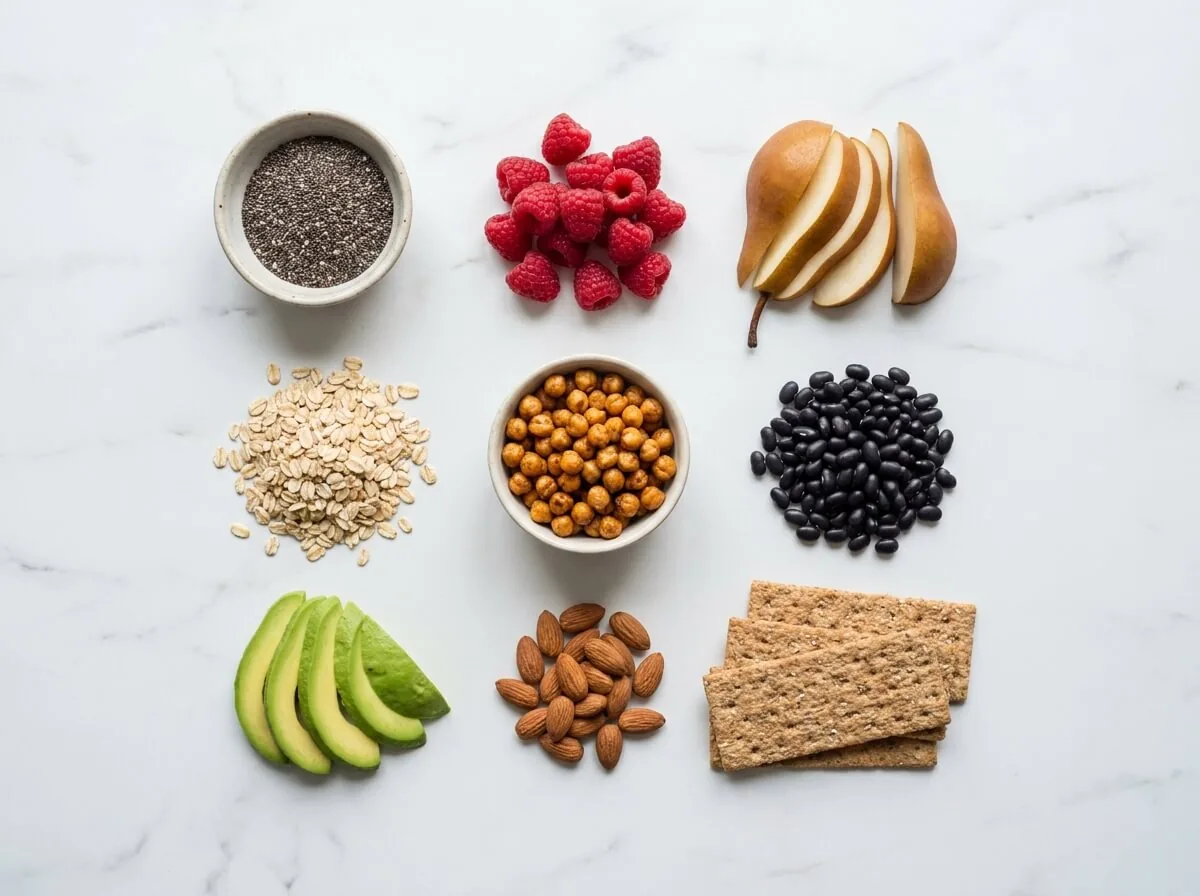
That range is your quick filter at the grocery store. Harvard Health recommends choosing crackers and breads with 3 grams or more per serving and cereals with 6 grams or more (Harvard Health, 2025). A “high fiber” claim on the front of a box means little on its own — flip it over and read the gram count, because a marketing buzzword and a real 5-gram serving are not the same thing. For the full breakdown of what qualifies, see our complete guide to high fiber snacks.
How to close your daily fiber gap with snacks
The math is friendlier than the daily number makes it look. Most people sit around 16 grams against a 25–38 gram goal — a gap of roughly 9 to 22 grams (Cleaneatz Kitchen, 2025). At 3 to 7 grams per snack, two or three well-chosen snacks close most of that gap without touching a single meal (Sun River Health, 2025).
| You are… | Target | Gap from ~16g | Snacks to close it |
|---|---|---|---|
| Woman 51+ | 22g | ~6g | One 6g snack (e.g., a pear + peanut butter) |
| Woman 19–50 | 25g | ~9g | Two snacks (a 5g + a 4g) |
| Man 51+ | 30g | ~14g | Two 7g snacks |
| Man 19–50 | 38g | ~22g | Three snacks (7g + 7g + 8g) |
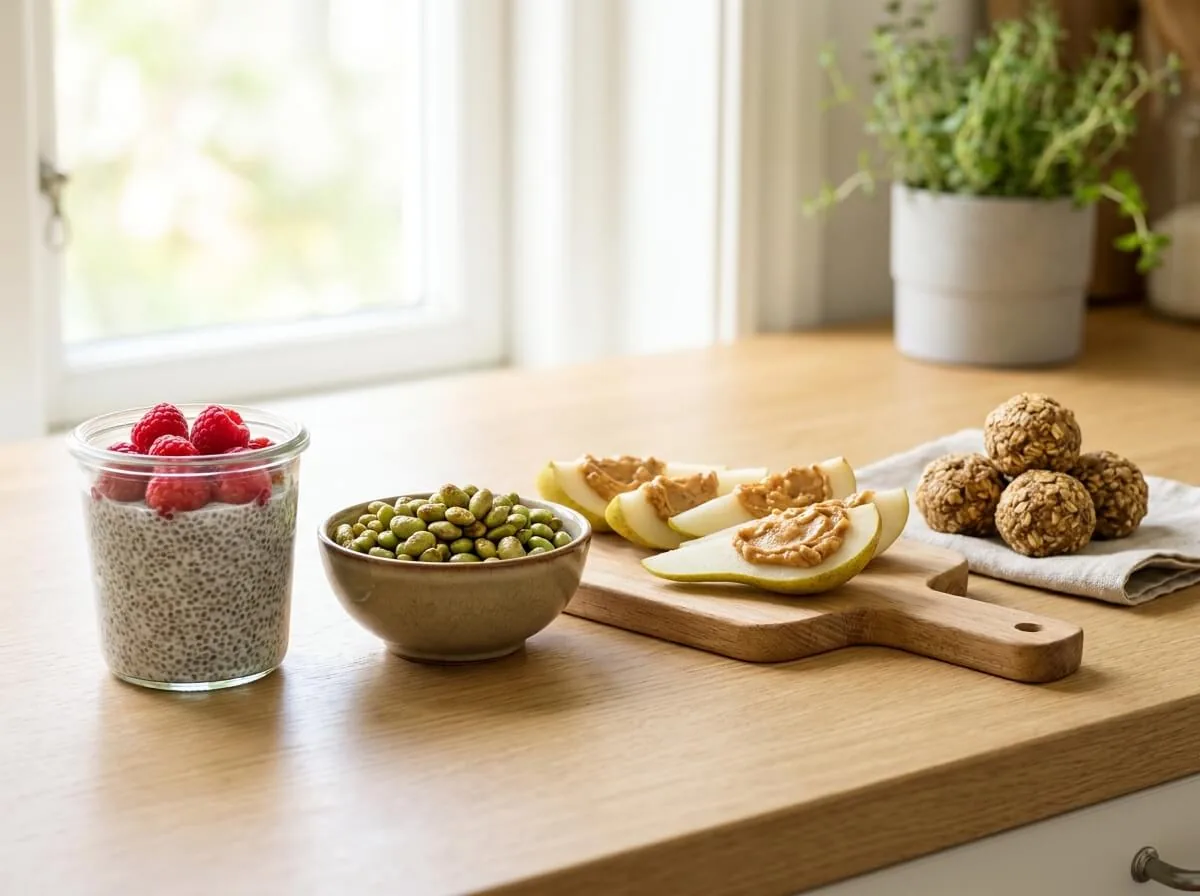
Real snacks make those grams concrete. Two tablespoons of chia in a pudding delivers about 10 grams of fiber on its own (Sun River Health, 2025); a half-cup of roasted edamame brings roughly 9 grams plus a hefty dose of protein; and a couple of no-bake energy bites land near 6 grams. Stack two or three and a 22-gram gap disappears.
Want the highest-return picks? Our roundup of high fiber high protein snacks pairs the gap-closing grams with staying power, and the high fiber high protein snacks list gives you 15 tested options with counts. For weight-loss-minded snacking, see high fiber snacks for weight loss.
Can you eat too much fiber per day?
Yes — though it takes effort. There’s no official upper limit for dietary fiber, but discomfort usually starts when intake consistently passes 40 to 50 grams a day, especially if you ramp up fast (Biology Insights, 2026). In 2026, University of Utah Health flagged exactly this risk with the fibermaxxing trend: piling on fiber overnight backfires (University of Utah Health, 2026).
The warning signs are gas, bloating, and irregularity — your gut telling you to slow down, not stop. The fix is pace plus water. Add about 5 grams of new fiber per week over three to four weeks, drinking more fluid as you go (Healthline, 2025). Done gradually, the payoff is real: in 2025, Tufts researchers reported that maxing out fiber intake carries broad, well-documented health benefits (Tufts Now, 2025), and NPR concluded the fibermaxxing hype is largely justified (NPR, 2026).
> **From the Flavor Flip test kitchen:** When we moved a staffer from ~15g to 30g, doing it in one day meant a miserable afternoon. Spreading the increase over four weeks — one new high-fiber snack at a time, with a full glass of water — got us there with zero bloat. Soluble-fiber snacks like chia pudding and oats were gentler to start than raw bran. If you would rather drink your fiber, chia seed water is the gentlest entry point.For the gut-health angle on ramping up, see high fiber snacks for gut health, and if you’re curious about the trend itself, our take on what fibermaxxing is and how to snack smart covers it in depth.
Start closing your gap today
You now know the numbers: 25g a day for women, 38g for men, 28g on the label, and at least 3g in every snack you reach for. The average American is about 16g short of the mark — but that gap is a snacking problem, and snacking is the easiest habit to change. Pick two or three high-fiber snacks, ramp up slowly with water, and you’ll close most of the distance this month.
Ready to start? Grab a few tested options from our high fiber high protein snacks, and save this guide on Pinterest so your daily and per-snack targets are one tap away.
Reviewed by the Flavor Flip test kitchen.
One easy way to close the gap: a serving of our dense bean salad has about 7.9g of fiber, roughly 28% of the 28g Daily Value.
Frequently Asked Questions
How much fiber should I eat per day?
Adults should aim for 25 grams a day if you’re a woman and 38 grams if you’re a man, or about 14 grams per 1,000 calories eaten (Healthline, 2025). Nutrition labels use a single 28-gram Daily Value as their reference point for everyone.
How much fiber should a snack have?
Aim for at least 3 grams of fiber per snack. The Cleveland Clinic counts 2 grams per serving as a “good source” and 5 grams or more as “excellent” (Cleveland Clinic, 2025). Dietitians suggest a 3-to-7-gram sweet spot for between-meal snacks.
How much fiber per day by age?
Targets rise with age, then ease off. Young children need 19–25 grams, teen boys peak at 38 grams, and adult women hold at 25 grams while men reach 38 (Cleaneatz Kitchen, 2025). After 50, women drop to about 22 grams and men to 30.
How many Americans actually get enough fiber?
Very few. Only about 5% of U.S. adults meet their daily fiber target, with average intake near 16 grams (Cleaneatz Kitchen, 2025). More than 90% of women and 97% of men fall short (American Society for Nutrition, 2025).
Can you eat too much fiber?
There’s no official upper limit, but most people feel gas and bloating once intake regularly tops 40 to 50 grams a day, especially if increased quickly (Biology Insights, 2026). Add roughly 5 grams of new fiber per week, with extra water, to avoid it.
Sources
- Healthline, How Much Fiber Per Day? Grams, Sources, Benefits, and More, retrieved 2026-07-16, https://www.healthline.com/health/food-nutrition/how-much-fiber-per-day
- Cleaneatz Kitchen, How Much Fiber Per Day? Daily Goals by Age & Sex, retrieved 2026-07-16, https://www.cleaneatzkitchen.com/a/blog/how-much-fiber-per-day
- Cleveland Clinic, High-Fiber Foods, retrieved 2026-07-16, https://health.clevelandclinic.org/high-fiber-foods
- Sun River Health, High-Fiber Snacks, retrieved 2026-07-16, https://www.sunriver.org/sun-river-healthy/high-fiber-snacks/
- Harvard Health, Should I be eating more fiber?, retrieved 2026-07-16, https://www.health.harvard.edu/blog/should-i-be-eating-more-fiber-2019022115927
- American Society for Nutrition, Most Americans are not getting enough fiber in our diets, retrieved 2026-07-16, https://nutrition.org/most-americans-are-not-getting-enough-fiber-in-our-diets/
- Real World Nutrition, What the 2025–2030 Dietary Guidelines Got Right, retrieved 2026-07-16, https://www.shelleyrael.com/blog/dga-part-3
- Biology Insights, How Much Fiber Is Too Much? Symptoms and Safe Limits, retrieved 2026-07-16, https://biologyinsights.com/how-much-fiber-is-too-much-symptoms-and-safe-limits/
- University of Utah Health, Fibermaxxing: Can You Have Too Much Fiber?, retrieved 2026-07-16, https://healthcare.utah.edu/healthfeed/2026/07/fibermaxxing-can-you-have-too-much-fiber
- Tufts Now, Maxing Out Your Fiber Intake Can Have Broad Health Benefits, retrieved 2026-07-16, https://now.tufts.edu/2025/10/30/maxing-out-your-fiber-intake-can-have-broad-health-benefits
- NPR, The ‘fibermaxxing’ trend has health benefits worth the hype, retrieved 2026-07-16, https://www.npr.org/2026/05/18/nx-s1-5821598/fibermaxxing-healthy-fiber-foods-diet-benefits