Best Cut of Beef: Tastiest, Most Tender, and Best Value (13 Cuts Ranked)
For taste, the best cut of beef is ribeye. For tenderness, it is tenderloin. For your money, it is chuck roast. Ribeye carries the most marbling (18.8g of fat per 3oz), tenderloin does almost no work on the animal so it stays butter-soft, and chuck roast returns 13.6g of protein per dollar once it has had time to braise. The rest of this guide ranks 13 cuts on all three.
Ground beef averaged $6.78 per pound across the first half of 2026, up from $3.64 in 2017 (U.S. Bureau of Labor Statistics, June 2026). Nearly every “best cut of beef” ranking you’ll find was written when beef was cheap, so they all crown the ribeye and move on.
That answer costs you money now. So I did something the other guides don’t: I pulled USDA protein data for every major cut, matched it against advertised retail prices from USDA’s report for the week ending August 6, 2026, and ranked all 13 by protein per dollar. The winner isn’t a steak.
Key Takeaways
- Chuck roast delivers 13.6g of protein per dollar. Ribeye delivers 5.2g (USDA, 2026).
- Protein barely varies by cut: 21g to 27g per 3oz. Price varies by 167%.
- Eye of round is the leanest at 4.8g fat per 3oz serving.
- For flavor, ribeye still wins. You’re paying for fat, not protein.
- For tenderness, tenderloin wins, but slow-cooked chuck can come close for about 40% less per pound.
What Is the Best Cut of Beef?
It depends on what you are optimizing: flavor, tenderness, budget, or leanness. Ribeye wins on flavor, and tenderloin is the most tender. Chuck roast wins on protein per dollar at 13.6g. Eye of round wins on leanness at 4.8g of fat per serving.
Most rankings only answer the first question, which is fine if money is no object. Americans ate about 60.0 pounds of beef per person in 2026 (USDA Economic Research Service, May 2026), and most of that isn’t steak. It’s the everyday cuts, where the price gap actually bites.
So this guide answers all three. Here’s what I found when I ran the numbers.
Our finding: Across all 13 cuts, protein ranges from 21g to 27g per 3oz serving. That’s a 29% spread. Price ranges from $6.74 to $17.99 per pound, a 167% spread. You aren’t buying protein when you trade up. You’re buying fat, tenderness, and a name.
The 13 Cuts of Beef, Ranked by Protein
Brisket flat leads on raw protein at 27g per 3oz cooked serving, followed by chuck roast and top round at 26g (USDA Agricultural Research Service, Release 3.01). Ribeye sits last at 20.9g. Every cut on this list clears 20g, which is why the spread matters less than most people assume.
A quick note on how to read that. These are cooked values for the lean and fat together, which is what you eat if you don’t trim the steak on your plate. Trim the fat off and protein per serving goes up slightly, because you’ve removed weight that wasn’t protein.
Brisket topping the list surprises people. It’s a working muscle from the chest, dense with protein and connective tissue, and it only becomes tender after hours of low heat. Our slow-cooked chuck roast uses the same principle on a cheaper cut.
Which Cut of Beef Gives You the Most Protein Per Dollar?
Chuck roast delivers 13.6g of protein per dollar spent, nearly triple the 4.6g you get from boneless short ribs. Eye of round roast is a close second at 13.5g. Ribeye, the cut most guides call the best, returns 5.2g per dollar. That’s a 2.6x gap for the same nutrient.
Here’s the method, so you can check it. USDA reports that 115g of raw beef yields 85g (3oz) cooked, so one pound of raw beef yields about 3.94 cooked servings. Multiply protein per serving by 3.94 to get protein per pound, then divide by the advertised price per pound from the USDA retail report for the week ending August 6, 2026.
| Cut | $/lb | Protein per 3oz | Protein per $ |
|---|---|---|---|
| Chuck roast, boneless | $7.53 | 26g | 13.6g |
| Eye of round roast | $7.30 | 25g | 13.5g |
| Bottom round roast | $6.74 | 23g | 13.5g |
| Brisket, flat | $8.99 | 27g | 11.8g |
| Top round steak | $11.55 | 26g | 8.9g |
| Flat iron steak | $9.76 | 21g | 8.5g |
| Flank steak | $11.22 | 23g | 8.1g |
| Tenderloin, whole | $12.99 | 26g | 7.9g |
| Sirloin steak, boneless | $11.98 | 23g | 7.6g |
| Tri-tip roast | $12.99 | 22g | 6.7g |
| NY strip steak | $17.02 | 24g | 5.6g |
| Ribeye steak, boneless | $15.99 | 20.9g | 5.2g |
| Short ribs, boneless | $17.99 | 21g | 4.6g |
Two caveats worth stating. These are advertised feature prices, so they run below full shelf price, and the four cheapest cuts all need long, slow cooking. You’re trading time for money. If you want that protein on a plate in fifteen minutes, flat iron at 8.5g per dollar is the best fast option on the board.
What Are the 8 Primal Cuts of Beef?
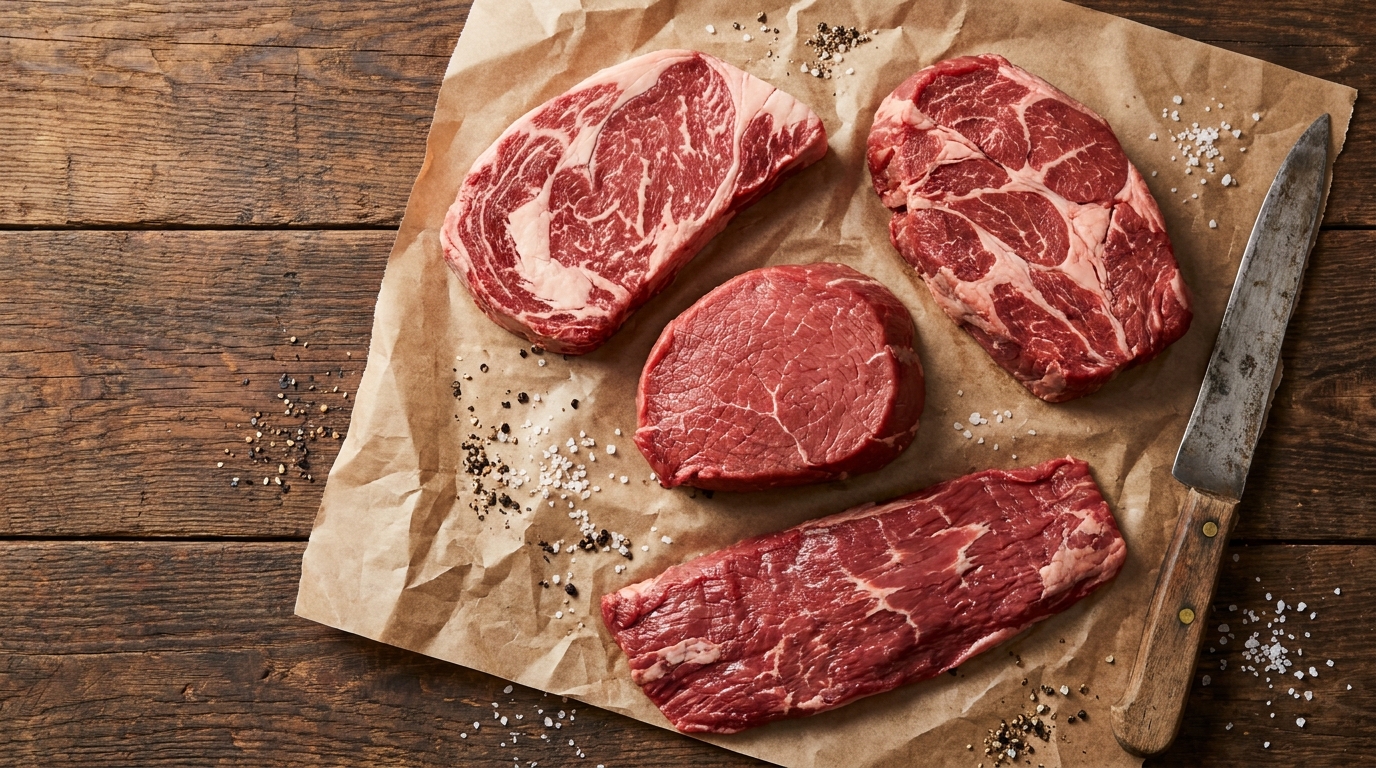
A beef carcass breaks down into eight primal cuts: chuck, rib, loin, round, flank, short plate, brisket, and shank. Every retail cut you’ve ever bought comes from one of these eight sections. Where a cut sits on the animal predicts almost everything about how it should be cooked.
You’ll see some sources count nine primals by listing sirloin separately from loin. Both conventions are in use. I’m using eight here, treating sirloin as part of the loin, which follows the standard USDA carcass breakdown.
Four terms come up constantly at the meat counter, so here’s what they actually mean:
- A primal cut is one of the eight large sections a carcass is first broken into. A subprimal is a smaller piece cut from a primal, and the steak in your cart is cut from that.
- Marbling refers to the flecks of intramuscular fat inside the meat, and it’s what USDA grades on. Prime has the most, then Choice, then Select.
- Grade means the USDA quality rating, which measures marbling and age. It says nothing about which cut you’re holding.
- Cutting against the grain means slicing across the muscle fibers rather than parallel to them, which shortens the fibers and makes a tough cut chew tender.
The rule is simple: muscles that work hard are tough and cheap. Muscles that don’t are tender and expensive. Chuck (shoulder) and round (rear leg) carry the animal around all day, so they’re full of connective tissue. The loin sits along the spine and does almost nothing, which is why tenderloin costs what it costs.
Shank and brisket are the hardest working of all. That’s why brisket needs twelve hours and why shank turns into the best beef stock you’ll ever make.
Which Cuts of Beef Are Actually Lean?
USDA labels a cut “lean” when it contains less than 10g of total fat, 4.5g or less of saturated fat, and less than 95mg of cholesterol per 100g serving. By that standard eye of round is the leanest cut on this list at 4.8g of fat per 3oz, followed by top round at 3.9g.
Look at that chart again. Top round and short ribs deliver almost identical protein, 26g against 21g, but short ribs carry five times the fat. Same animal, same nutrient, wildly different package.
One thing worth knowing if you go looking for a count of lean cuts: you’ll find 19, 36, and “more than 38” all cited as the official number. They’re all defensible, because USDA maintains two separate definitions. Food safety labeling calls a product lean at no more than 10% fat by weight, while nutrition labeling uses the per-100g thresholds above. Add that different database releases cover different cuts and the count moves. Trust the thresholds, not the headline number.
What Are the Most Tender Cuts of Beef?
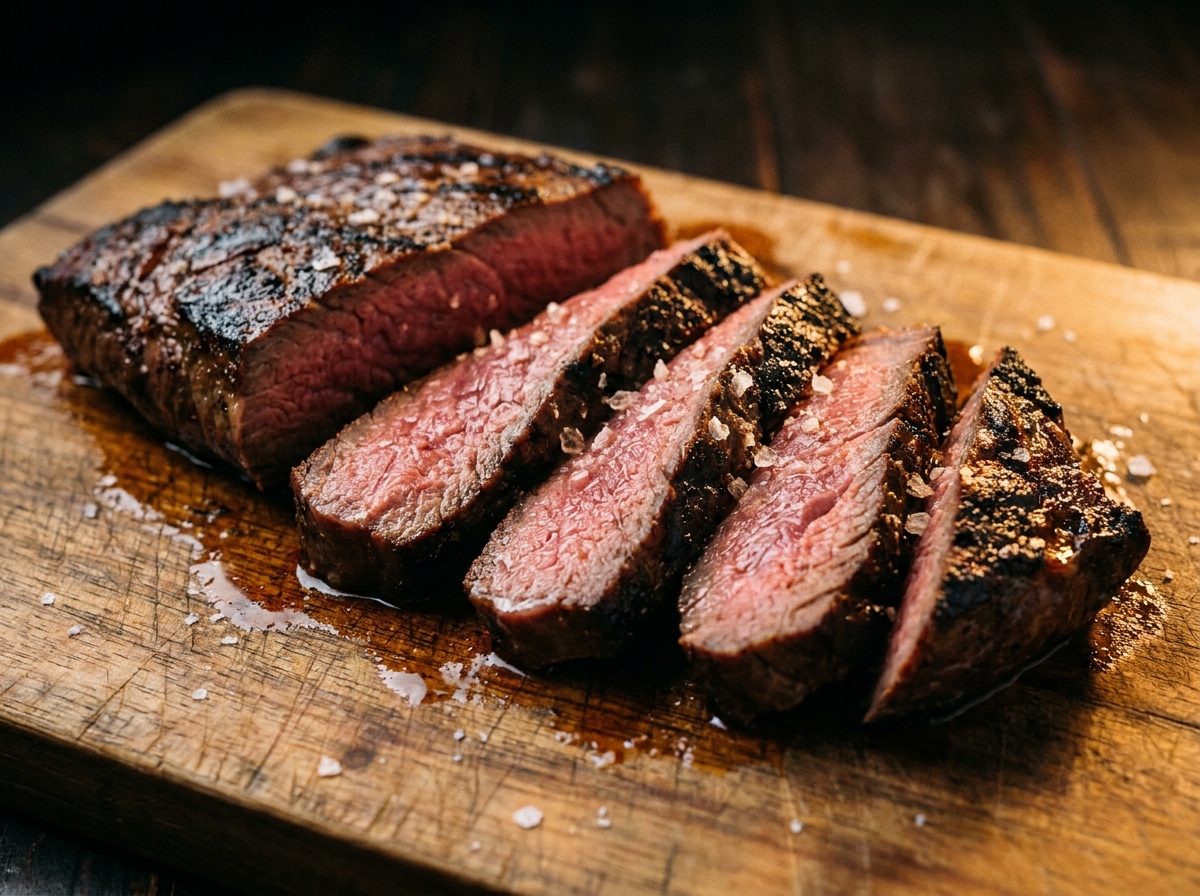
Tenderloin is the most tender cut of beef, which is why whole tenderloin runs $12.99 per pound and filet mignon runs $36.10 (USDA AMS, week ending 8/6/2026). Tenderness tracks one thing only: how little the muscle worked while the animal was alive.
 Save
SaveThat single rule explains the whole price list. The tenderloin is tucked under the spine and does essentially nothing. Ribeye and strip sit nearby and do slightly more. Shank walks every step the animal takes.
So is tenderness worth paying for? Sometimes. But notice that tenderloin returns 7.9g of protein per dollar while chuck roast returns 13.6g, and after eight hours in a slow cooker the chuck is arguably more tender than a filet. Tenderness you buy costs money. Tenderness you cook costs time.
How Should You Cook Each Cut of Beef?
Match the cooking method to how hard the muscle worked. Tender loin and rib cuts want fast, dry, high heat. Hard-working chuck, round, brisket, and shank want low, slow, moist heat, which is what converts their connective tissue into gelatin.
Get this backwards and you ruin dinner. A ribeye braised for three hours turns gray and stringy. A chuck roast seared for eight minutes is genuinely inedible.
Fast and dry (grill, sear, broil): ribeye, NY strip, tenderloin, sirloin, flat iron, flank, skirt, tri-tip. Pull steaks at 130°F for medium rare and rest them five minutes.
Low and slow (braise, slow cook, smoke): chuck roast, brisket, short ribs, shank, bottom round. Give them three hours minimum, and eight is better for brisket.
Cut against the grain: flank, skirt, tri-tip, and flat iron have long visible muscle fibers. Slicing across them shortens the fibers and makes a chewy cut tender. This one technique matters more than anything else you’ll do to a flank steak.
Here is the same idea as a quick reference for all 13 cuts in the ranking, including what each one is good for when you cook once and eat all week.
| Cut | Best cooking method | Meal-prep use |
|---|---|---|
| Chuck roast | Slow cooker or braise, 3+ hours, until it shreds | Shredded beef for tacos, bowls, and sandwiches; freezes well in its liquid |
| Eye of round | Roast to medium rare, rest, slice very thin | Cold sliced beef for lunches and wraps |
| Bottom round | Braise or slow cook, or roast and slice thin | Pot roast portions, French dip-style sandwiches |
| Brisket (flat) | Low oven, smoker, or slow cooker, 6 to 8 hours | Sliced or chopped for sandwiches; reheat gently with broth |
| Top round steak | Marinate, then sear hot and slice against the grain | Stir-fry strips and steak salads |
| Flat iron | Sear, grill, or air fry to medium rare | Sliced steak bowls |
| Flank steak | Marinate, grill or broil fast, slice against the grain | Fajitas and burrito bowls |
| Tenderloin | Sear, then finish in the oven; don’t go past medium | Best eaten fresh; leftovers are good cold and thinly sliced |
| Sirloin | Grill, sear, or air fry | Steak and vegetable meal-prep containers |
| Tri-tip | Grill or roast, rest, slice against the grain | Sandwiches and grain bowls |
| NY strip | Hot cast iron or grill | Best fresh |
| Ribeye | Hot cast iron or grill | Best fresh |
| Short ribs | Braise 3 hours, or slow cook | Reheats well; the braising liquid becomes a sauce |
Want to put this into practice? A chuck roast is the base of our slow cooker Amish beef roast with apples, and our beef tataki au poivre shows the opposite approach: a tender cut seared hard for a minute a side and sliced thin. For a full month of dinners that use both styles, see our monthly meal planning guide.
Which Cuts Work in an Air Fryer?
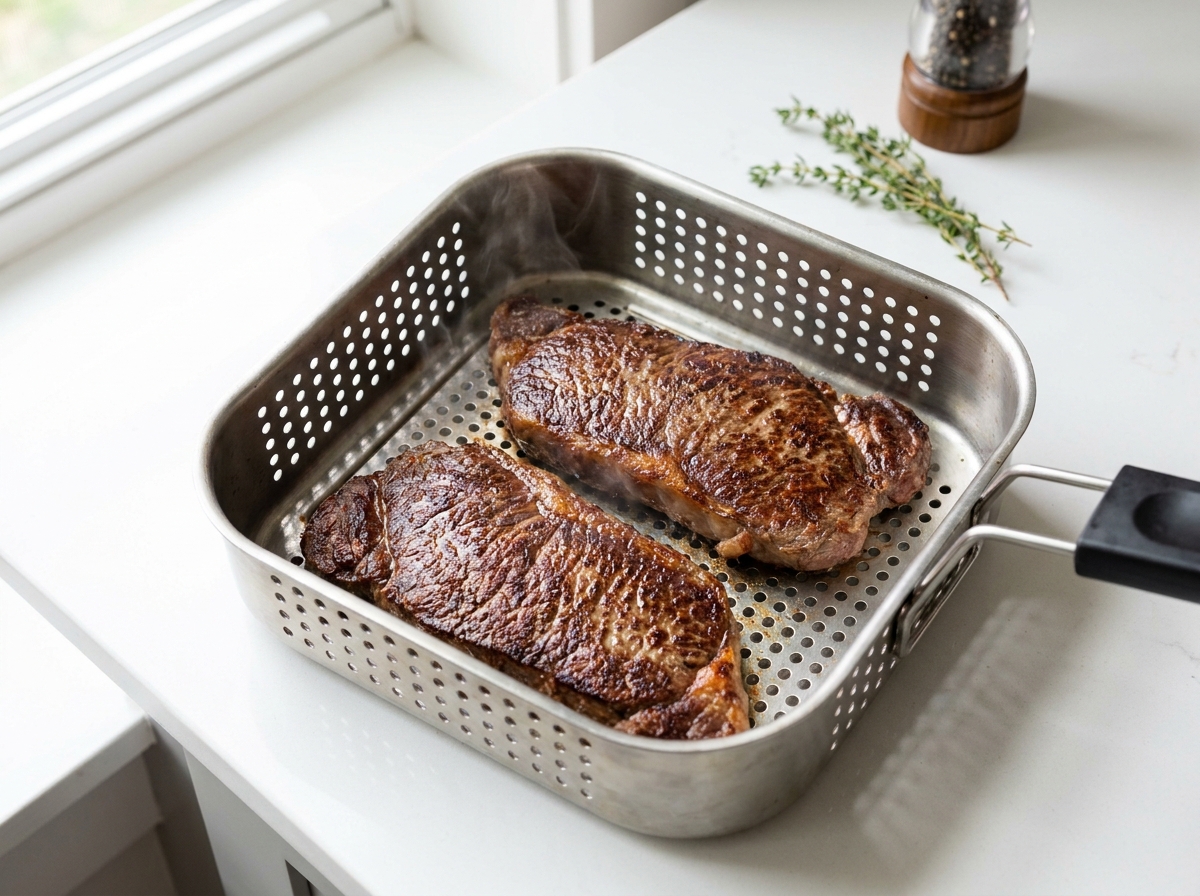
Air fryers handle thin, tender, quick-cooking cuts and fail at everything else. Flat iron, sirloin, and thin-cut strip steaks work well at 400°F for 8 to 12 minutes, flipping halfway. The circulating air gives you a genuine crust without heating the kitchen.
 Save
SaveWhat doesn’t work: chuck roast, brisket, and short ribs. Those need moisture and hours, and an air fryer supplies neither. If you love your air fryer as much as we love ours, stick to steaks under an inch thick. Our air fryer salmon uses the same fast, dry heat principle on a different protein.
How Do You Buy Beef Without Overpaying in 2026?
Buy on the primal, not the name. Beef cow inventory hit 28.5 million head as of July 1, 2026, down 1% year over year and the smallest July inventory on record (USDA NASS, July 2026). Tight supply means premium cuts keep climbing while working cuts stay reachable.
Ground beef has risen 86% since its 2017 low of $3.64 per pound. That climb is the reason a protein-per-dollar ranking is worth running at all in 2026.
Three habits that actually save money:
- Buy roasts, not steaks. Chuck, bottom round, and eye of round roasts occupy the top four slots on protein per dollar. Every one is a roast.
- Learn one substitution. London broil at $7.22 per pound is usually just top round or flank under a marketing name. Same muscle, lower price. For example, swapping a $11.55 top round steak for the $7.22 London broil beside it saves about 37% on identical meat.
- Watch grade, not just cut. Select grade costs less than Choice and carries less fat. For a braise, that fat was going to render out anyway.
Planning meals around cheaper cuts works best when you shop with a list. Our monthly meal planning guide covers how to build one around what’s on sale.
Frequently Asked Questions
What are the 12 basic beef cuts?
Most charts show eight primals (chuck, rib, loin, round, flank, short plate, brisket, shank) which then break into the common retail cuts: ribeye, NY strip, tenderloin, sirloin, flank, skirt, brisket, chuck roast, short ribs, round steak, tri-tip, and flat iron. Protein across these ranges from 21g to 27g per 3oz (USDA ARS, Release 3.01).
What is the best cut of beef for the money?
Boneless chuck roast, at 13.6g of protein per dollar based on USDA nutrient data and advertised retail prices for the week ending 8/6/2026. Eye of round and bottom round roasts follow at 13.5g. All three cost roughly half what ribeye costs per gram of protein.
What are the 5 types of steak?
The five most commonly sold steaks are ribeye, NY strip, tenderloin (filet mignon), sirloin, and T-bone or porterhouse, which combines strip and tenderloin. Prices for the week ending 8/6/2026 ran from $10.23 per pound for T-bone to $36.10 for filet mignon (USDA AMS, July 2026).
Which cut of beef is the healthiest?
Eye of round and top round are the leanest, at 4.8g and 3.9g of total fat per 3oz cooked serving while still delivering 25g and 26g of protein (USDA ARS, Release 3.01). Both clear the USDA lean threshold of under 10g total fat per 100g with room to spare.
What is the most tender cut of beef?
Tenderloin, because the muscle does almost no work while the animal is alive. It’s also among the priciest, at $12.99 per pound whole and $36.10 cut into filet mignon (USDA AMS, week ending 8/6/2026). Slow-cooked chuck can reach comparable tenderness for a third of the price.
The Bottom Line
- Best overall value: boneless chuck roast, 13.6g protein per dollar
- Leanest: eye of round, 4.8g fat per 3oz serving
- Best fast-cooking value: flat iron steak, 8.5g protein per dollar in under 15 minutes
- Best flavor: ribeye, if you accept you’re paying for fat rather than protein
The honest summary is that beef cuts differ far less in protein than in price. Once you know that, “what’s the best cut of beef” turns into a much easier question: what are you cooking tonight, and how long do you have?
Start with a slow cooker chuck roast if you want the value play, or beef tataki au poivre if tonight is a tenderloin night. For everyday cooking, our easy ground beef tacos stretch a pound further than almost anything else.
Sources
- U.S. Department of Agriculture, Agricultural Research Service. USDA Nutrient Data Set for Retail Beef Cuts from SR, Release 3.01. Retrieved 2026-08-02. https://www.ars.usda.gov/ARSUserFiles/80400535/Data/Meat/Retail_Beef_Cuts03.pdf
- U.S. Department of Agriculture, Agricultural Marketing Service. National Retail Report: Beef, week ending 8/6/2026. Retrieved 2026-08-02. https://www.ams.usda.gov/mnreports/AMS_3228.pdf
- U.S. Bureau of Labor Statistics. Average Price Data: Ground Beef, 100% Beef (APU0000703112), via FRED. Retrieved 2026-08-02. https://fred.stlouisfed.org/series/APU0000703112
- U.S. Department of Agriculture, Economic Research Service. Livestock, Dairy, and Poultry Outlook, LDP-M-371, May 2026. Retrieved 2026-08-02. https://ers.usda.gov/sites/default/files/_laserfiche/outlooks/112616/LDP-M-371.pdf
- U.S. Department of Agriculture, National Agricultural Statistics Service. Cattle Inventory Report, July 24, 2026. Retrieved 2026-08-02. https://www.nass.usda.gov/Newsroom/2026/07-24-2026.php
Methodology: Protein per dollar = (protein grams per 3oz cooked serving x 3.944 servings per raw pound) / advertised price per pound. The 3.944 figure comes from the USDA ARS yield standard of 115g raw yielding 85g cooked. Nutrient values are USDA Choice grade, lean and fat, cooked. Prices are weighted-average advertised retail prices, which run below full shelf price. Eye of round nutrient data is from the eye of round steak, matched to the eye of round roast price (same muscle). Ribeye nutrient data is from USDA’s rib, small end (ribs 10-12), trimmed to 1/8 inch fat.